



Article

Article

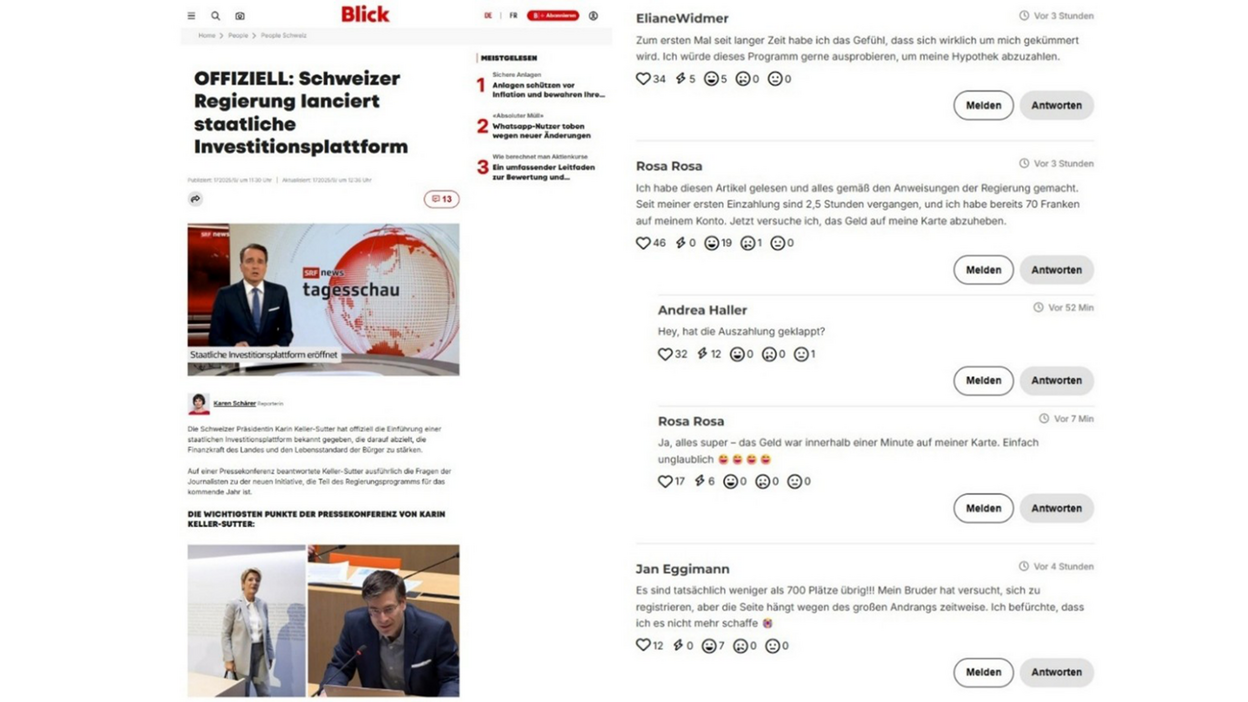
Now the President of the University of St.Gallen (HSG) Prof. Manuel Ammann has been targeted as well: a photo of him appeared on websites with cryptic URLs in January 2026. It was accompanied by photos of Federal Councillor Karin Keller-Sutter and other figures from the world of science and business. The websites imitated the layout of 20 Minuten or Blick. It was in the style of a news article with fabricated quotes and manipulated images, and it gave the impression that the Federal Council had launched a state investment platform at a media conference. Anyone who trusted the platform, visited it and transferred money is likely to have lost everything. The situation is very unpleasant for the individuals shown, especially since criminal proceedings relating to identity theft often have a sobering outcome. However, it’s even worse for all those who trusted the matter, visited the platform, and transferred money: they are likely to have lost everything. Unfortunately, online investment fraud is not a new phenomenon, but a widespread one.
As the study “Swiss Crime Survey 2022” shows, investment fraud is one of the most common crimes in this country. “Our victim survey, which also measures offences that are not reported to the police, shows that 8.4 per cent of the Swiss population were victims of at least attempted fraud in 2022,” says study author Nora Markwalder, Professor of Criminal Law, Criminal Procedure and Criminology at the University of St.Gallen. “The most common form is online investment fraud, accounting for over a quarter of cases.” Although this is a mass crime, it is rarely reported. “Only 14.8 per cent of those affected said they had reported the fraud to the police.” This is very low, Nora Markwalder points out: “Only sexual offences have a lower reporting rate.” A reason may be that many victims are ashamed of having fallen for it. Consequently, the estimated total damage of around CHF 250 million in Switzerland for 2025 should be treated with caution. Including unreported cases, the figure is likely to be significantly higher.
But back to the dubious website: how did people get there? Through online advertising served by Microsoft Advertising. These ads advertised a “method” for generating a “second income”. Interestingly, the sender of the ad was a website that, at first glance, gave the impression of being a regular platform for online courses. Upon closer inspection, however, its credibility is questionable: the company initially used the address and telephone number of a hotel in Yverdon, and later, changed it to a cultural institution in Lucerne. And expectedly. the company cannot be found in the commercial register. But what is the point of all this? Perhaps just to give the appearance of being a reputable advertiser?
Online investment fraud would hardly be so successful without the rise of "programmatic advertising". The proportion of online advertising that is placed fully automatically has been rising steadily for years. According to Statista Market Insights, over 83 per cent of all online advertising is now placed in this way. Controls are minimal to non-existent.
by Professor Marcus Schögel, IMC-HSG
Programmatic advertising is the dominant model for digital advertising. It is a highly automated market in which attention is traded as a standardised commodity (impressions) in real time.
Prices are determined via algorithmic auctions (real-time bidding), controlled by forecasts of the probability of clicks or conversions. The underlying business model is transaction- and volume-driven. Platforms and intermediaries earn commissions on media budgets, supplemented by data, targeting, optimisation and infrastructure services. Vertically integrated systems (e.g. search, social, retail media) that control inventory, user data, auctions and placement are particularly profitable. Economies of scale are considerable: marginal costs per additional impression tend towards zero, while additional auctions generate immediate revenue. The advantages for providers are high automation, scalability and predictable, performance-based revenues.
Users, on the other hand, feel the downside of the efficiency model. Since optimisation logic primarily targets reach, engagement and conversion, context, quality and accuracy take a back seat. Users experience high advertising density, a blurring of the line between content and advertising, data-driven targeting with a loss of control, and increased exposure to misleading or fraudulent ads. The resulting costs in terms of trust and attention are systematically externalised. The connection to ad fraud is inherent. Low barriers to entry, automation and scaling make fraudulent actors short-term rational market participants. Since revenues depend on volume and liability and reputational damage are hardly internalised, ad fraud is apparently an unpleasant but difficult to remedy “by-product” from the platforms' point of view.
AI acts as an amplifier in this process. AI models control bids, targeting and budget allocation in real time, massively increasing efficiency and speed. Fraudsters also use AI to quickly vary and circumvent controls. The result is an algorithmic arms race in which efficiency scales faster than governance.
2018 musste sich Facebook-Gründer Mark Zuckerberg im Zuge des Cambridge-Analytica-Skandals vor einem US-Senatsausschuss erklären. Ihm war anzusehen, wie unangenehm die Situation war. Als ihn der inzwischen verstorbene Senator Orrin Hatch aber fragte, wie Facebook ein Geschäftsmodell aufrechterhalten könne, bei dem man nicht für Dienste bezahle, kam die Antwort schnell und unbekümmert: «Senator, wir schalten Anzeigen.» Daran hat sich nichts geändert. Worüber man beim Mutterkonzern Meta aber ungern spricht: Betrügerische Anzeigen sind eine wesentlicher Teil davon. Meta scheint dies zu wissen, wie die Nachrichtenagentur Reuters kürzlich bekanntmachte, nachdem interne Dokumente den Weg zur Redaktion fanden. Demnach sind auf den Plattformen des Konzerns bis zu 15 Milliarden «Anzeigen mit höherem Risiko» zu sehen. Tagtäglich! Angesichts der rund 16 Milliarden USD, die Meta mit solchen Anzeigen jährlich verdienen soll, ist es fast schon verständlich, dass man sich das lukrative Geschäft nicht selbst kaputt machen will. Wie Reuters-Autor Jeff Horwitz in einem weiteren Artikel am Beispiel Japan aufzeigt, scheut der Konzern keine Mühe, um das Problem zu verschleiern und weiteren Regulierungen zu entgehen.
Nicht im Silicon Valley, sondern in Sihanoukville oder Bavet (Kambodscha) sind etwas andere Technologie-Unternehmen domiziliert: Sogenannte «Scam Centers», oft unter chinesischer Führung, betreiben u.a. Online-Anlagebetrug als Geschäftsmodell. Menschen werden dort unter sklavenartigen Bedingungen gezwungen, ahnungslosen Opfern das Geld abzuknüpfen. Kambodscha hat sich in den letzten Jahren zum globalen Hub für solche Unternehmungen entwickelt. Amnesty International hat über 50 solcher Centers in Kambodscha identifiziert. Im Zuge der Auseinandersetzungen im Grenzgebiet zu Thailand nahm die thailändische Armee kürzlich auch «Hotels» und «Casinos» ins Visier, bei denen es sich tatsächlich um Scam Centers handeln dürfte.
Hinter betrügerischen Anzeigen im Web stecken also oft kriminelle Organisationen, die ihr Geschäft unter Missachtung von Gesetzen und Menschenrechten betreiben. Dass westliche, börsennotierte Firmen nicht alles in ihrer Macht stehende unternehmen, solche Aktivitäten auf ihren Plattformen zu unterbinden, ist bedenklich. Höchste Zeit, dass Gesetzgeber Druck machen. Es eilt, da KI eine Zunahme betrügerischer Aktivitäten bewirkt. «Dies ist ein grosses Problem –in der Schweiz und in der EU», sagt Professorin Miriam Buiten, die an der HSG u.a. zu Technologie- und Informationsrecht lehrt und forscht. Aus regulatorischer Sicht kommen zwei Themen zusammen:
die Notwendigkeit, Plattformen zu verpflichten, betrügerische Werbetreibende konsequent zu sperren
der Bedarf an Regeln zu KI und Deepfakes, verbunden mit der Pflicht für Plattformen, betrügerische Inhalte aktiv zu erkennen und zu entfernen.
In der EU setzt der Digital Services Act (DSA) genau hier an. Er verpflichtet Plattformen insbesondere dazu,
Werbetreibende zu überprüfen («Know Your Business Customer»), damit sich Betrüger nicht hinter falschen Identitäten verstecken können
Transparenz bei Werbung sicherzustellen (wer bezahlt hat und warum Nutzer:innen diese Werbung sehen)
Illegale und betrügerische Werbung rasch zu entfernen, sobald sie erkannt oder gemeldet wird
Systemische Risiken zu analysieren und zu reduzieren, insbesondere im Zusammenhang mit Scam- und Täuschungswerbung (vor allem bei sehr grossen Plattformen)
Melde- und Beschwerdemechanismen bereitzustellen.
Die Europäische Kommission hat mit der Durchsetzung der DSA-Pflichten begonnen. So hat sich TikTok nach einer Untersuchung im letzten Jahr verpflichtet, die Werbetransparenz zu verbessern, damit Nutzerinnen und Nutzer potenzielle Scams leichter erkennen. Im September 2025 hat die Kommission zudem Informationsanfragen an grosse Plattformen und Suchmaschinen geschickt, um zu klären, wie sie Risiken im Zusammenhang mit Finanzbetrug identifizieren und managen. «Die Durchsetzung ist aber noch alles andere als perfekt», gibt Miriam Buiten zu bedenken. In der Praxis werden betrügerische Werbetreibende teilweise gesperrt, doch viele Scam-Anzeigen bleiben lange online oder tauchen unter neuen Accounts rasch wieder auf. Echte Veränderungen verlaufen langsam und hängen letztlich davon ab, ob Plattformen betrügerische Werbekunden konsequent ausschliessen – auch wenn ihnen damit Einnahmen entgehen.
«Auch in der Schweiz muss man von den Plattformen stärker verlangen, Betrug und Scam-Werbung wirksamer zu bekämpfen» ist Miriam Buiten überzeugt. Eine allgemeine Konsumenten‑Schutzregelung reiche nicht aus, weil betrügerischen Websites nur mithilfe der Plattformen Reichweite und somit potenzielle Opfer erreichen. Zudem seien die Plattformen selbst am besten in der Lage, missbräuchliche Inhalte zu erkennen und zu entfernen. Es sei gerechtfertigt, dass sie dafür Verantwortung übernehmen, weil sie von diesen Anzeigen profitieren. «In der Schweiz gibt es inzwischen einen Vorschlag für eine Plattformregulierung, leider nicht annähernd so weitreichend wie in der EU. Beispiele wie die eingangs Beschriebenen zeigen, dass es eine harte Plattformregulierung braucht, um echte Veränderungen zu bewirken.»