






Economies of Crime

The latest issue of the university magazine HSG FOCUS focuses on the complex intersections between economics, law, and crime – from global drug markets and everyday counterfeiting to accounting fraud and organised crime in Switzerland. The articles show how illegal practices depend on legal structures – and where politics, regulation, and society need to take action.
"Facts and figures on the global shadow economy": Daniel Sager's video provides an overview of the extent and geographical aspects of the most important illegal markets worldwide.
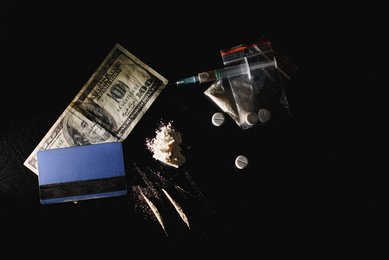
"Chemistry and technology fuel the drug trade": Matías Dewey and Alvaro Pastor highlight how closely the illegal drug trade is intertwined with legal markets. Chemicals from global industry, varying government regulations, and digital technologies enable flexible value chains that are difficult to control. From coca cultivation in the Peruvian Amazon to encrypted messengers and digital payment systems, the article shows that illegal economies cannot function without legal infrastructures – and why regulation, platform control, and government enforcement need to be rethought.
"Homo economicus in crime": Nora Markwalder asks whether criminals act rationally. She explains rational theories of crime, according to which perpetrators weigh up costs and benefits and make targeted use of opportunities – an approach that enables prevention. At the same time, she points out the limitations of this view: many crimes are committed without rational calculation and are more strongly influenced by social or psychological factors.
In his article "The Gucci bag and the big business of counterfeit goods", Markus Müller-Chen sheds light on the billion-pound trade in counterfeit products. High original prices, status consciousness, online availability, and deceptively genuine "super fakes" drive demand.
The article highlights legal remedies, but also the risks for companies, jobs, and buyers, who may be liable to prosecution. Under the title "Accounting scandals: it often ends badly when you embellish the figures", Peter Leibfried analyses the similarities behind cases such as Wirecard, Enron, and Signa.
It shows that despite regulation, patterns repeat themselves: overvalued assets, hidden debts, false consolidation. It often starts with pressure and grey areas, not with intent. Leibfried advocates for better education, ethical awareness, and a critical approach to financial data.
"The Mafia is everywhere. Even in allotment gardens": Henry Habegger shows how organised crime benefits from liberal structures in Switzerland. Lenient penalties, federalism, and enforcement deficits create loopholes. Initial reforms point to a rethink – but consistent enforcement remains crucial.

Study

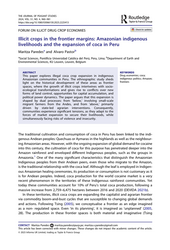
Maritza Paredes / Alvaro Pastor: Illicit crops in the frontier margins: Amazonian indigenous livelihoods and the expansion of coca in Peru (2023)

The expansion of coca-cocaine markets in the Amazon is not solely attributable to state failure or criminal groups. This paper demonstrates how long-term development projects in the Amazon frequently result in the opening of agricultural frontiers, the attraction of settlers, and the transformation of the ecology. The unintended consequences of these state-development projects are the progressive impoverishment of local agricultural communities, the degradation of soil quality, and the deterioration of land security tenure. In this scenario, coca crops emerge as the most viable option for ensuring livelihoods.

Study

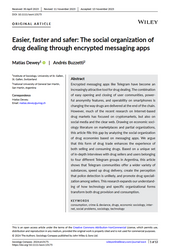
Matías Dewey / Andrés Buzzetti: Easier, Faster and Safer: The Social Organization of Drug Dealing through Encrypted Messaging Apps (2024)

Digitalization is not limited to the legal economy. It also permeates illegal markets, improving the way people exchange goods and services while making detection much more difficult. For example, this research shows that perfectly legal apps are used to sell drugs. The experience of drug sellers and users is quite clear: apps like Telegram make drug market activity easier, faster, and safer. This article was the first to bring this phenomenon to light.

Website

Stop Piracy

The Swiss platform Stop Piracy provides reliable, fact-based information on counterfeiting and piracy, thereby making an important contribution to raising public awareness. The compact fact sheets are particularly helpful, as they clearly show how to recognise counterfeits and dubious online providers. Anyone who wants to deal with the topic not only theoretically but also practically will find an excellent point of contact here.

Book

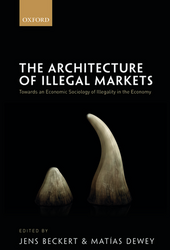
Jens Beckert / Matías Dewey: The Architecture of Illegal Markets. Towards an Economic Sociology of Illegality in the Economy (2017)

If you want to understand how illegal markets work — and not just assume that they are merely the consequence of criminal organizations or failed states — this book offers a fresh perspective on hard-to-research economies. It pays attention to additional elements that constitute economies beyond the law, such as credit, infrastructure, social acceptance, and the meaning of commodities. It is the first serious attempt to conceptualize, classify, and suggest future research directions on illegal markets from a sociological perspective.

Film

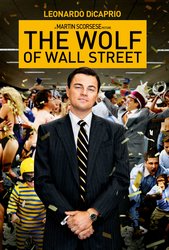
Martin Scorsese: The Wolf of Wall Street (2013)

If you want to know how opportunities encourage crime, we recommend the film The Wolf of Wall Street. The film is based on the story of stockbroker Jordan Belfort and is set in New York in the 1980s and 1990s. The scene of the crime is the barely regulated market for so-called penny stocks. The film shows how easy it was to manipulate the market and defraud unsuspecting customers at the time and how low the chance of getting caught was – especially when you lock the financial regulators away in ice-cold offices...

Book

Christof Schürmann: Die Bilanztrickser – wie Unternehmen ihre Zahlen frisieren und den Anleger täuschen (2003)

As a journalist at the German business magazine WirtschafsWoche, Christof Schürmann has been critically monitoring corporate reporting for many years. He not only looks at general business and financial developments but also addresses related issues of accounting and financial reporting. He shows where there is room for manoeuvre and provides examples of how this can be exploited.

Study

OECD: Counterfeiting, Piracy and the Swiss Economy 2025

For an additional economic perspective: the OECD study highlights the economic consequences of counterfeiting and piracy in Switzerland. It shows how severely export-oriented industries such as the watch and pharmaceutical industries are affected and provides up-to-date data on trade routes, damage costs and global contexts.

Stay focused

From the feeds of universities, think tanks, and the media.
11.01.2026
09.01.2026
The new threat? An imperial America
Politics

The new threat? An imperial America

The new threat? An imperial America 27 January 2026 — 4:00PM TO 5:00PM Anonymous (not verified) 9 January 2026 Chatham House and Online What President Trump’s foreign policy means for Europe, Russia and China. The implications of President Trump’s foreign policy means for Europe, Russia and China. President Trump’s second presidency poses a stark question: has the United States shifted from a reluctant hegemon to something resembling an imperial power?The administration’s foreign policy is characterised by transactional deal-making, disregard for international norms, indifference to traditional allies, and a willingness to use hard military power. The operation to capture Venezuelan President Nicolás Maduro brought these tendencies into sharp focus. For Europe, the implications are profound. This shift threatens not only the future of NATO and the European defence architecture that the United States underpins, but also raises direct concerns about territorial integrity, given explicit threats to annex Greenland, part of NATO ally Denmark.The Maduro operation underscored the administration’s readiness to deploy US forces to achieve foreign policy objectives. All loosely aligned around a hemispheric vision in which Washington dominates the Western Hemisphere. Countries outside Trump’s preferred orbit can not rely on American intervention. Those within it are proceeding with caution.For Russia and China, this posture presents both risks and opportunities. Moscow faces an unpredictable United States focused on leverage, seeking grand bargains backed by military power. Beijing, meanwhile, confronts a more openly confrontational America, prepared to weaponise tariffs, technology controls, and security partnerships across the Indo-Pacific.The result is a more brittle international order—one in which power is exercised bluntly, alliances are strained, and the risk of miscalculation steadily increases. A doctrine of ‘might makes right’.

Chatham House

07.01.2026
05.01.2026
04.01.2026
The US capture of President Nicolás Maduro – and attacks on Venezuela – have no justification in international law
Politics

The US capture of President Nicolás Maduro – and attacks on Venezuela – have no justification in international law

The US capture of President Nicolás Maduro – and attacks on Venezuela – have no justification in international law Expert comment jon.wallace 4 January 2026 This may be the moment when Western Europe realizes that the US has abandoned the core values that united them for the past century, writes the head of Chatham House’s International Law Programme. The capture of Venezuelan President Nicolás Maduro and his wife by US forces operating in Venezuela, and his forced transfer to the US for trial, poses a significant challenge for international law. The US has described the operation as a judicial ‘extraction mission’ undertaken by law enforcement operatives supported by the military. Yet this was a military operation of considerable scale, involving strikes on military targets in and around Caracas, the capital, and the forcible abduction of a sitting president by US special forces. It is clearly a significant violation of Venezuelan sovereignty and the UN Charter. This fact is compounded by President Donald Trump’s announcement during his press conference of 3 January that the US will ‘run’ Venezuela and administer a political transition, or regime change, under the threat of further, more massive uses of force. In addition, there seems to be a determination to use the threat of force to extract funds and resources in compensation for supposed ‘stolen’ or nationalized US assets and oil. Justifications are hard to seeIt is difficult to conceive of possible legal justifications for transporting Maduro to the US, or for the attacks. There is no UN Security Council mandate that might authorize force. Clearly, this was not an instance of a US act of self-defence triggered by a prior or ongoing armed attack by Venezuela.  The White House asserts that it is defending the American people from the devastating consequences of the illegal importation of drugs by ‘narco-terrorists’ – consequences that could be compared to an armed attack against the US. However, in international law, only a kinetic assault with military or similar means qualifies as a trigger for self-defence.‘Restoring democracy’This leaves the argument of pro-democratic intervention. Notably, the US did not use pro-democratic action as a formal legal justification when it invaded Grenada in 1983 and displaced its communist-leaning government. Neither did it do so when it invaded Panama in 1989 and captured President Manuel A. Noriega, with a view to putting him on trial for drugs offenses.Washington avoided doing so because it feared creating a precedent that would justify pro-democratic interventions by other countries which it might oppose. Instead, it relied on an unconvincing claim to self-defence.In the case of Venezuela, the US alleges that Maduro stole the presidential poll of 2024, that opposition candidate Edmundo Gonzales Urrutia was the true victor, and that Venezuelan authorities falsified the result of 2025’s parliamentary elections. While this is disputed, there is little doubt that the electoral process was deeply flawed.  Related work US to ‘run’ Venezuela after Maduro captured, says Trump: Early analysis from Chatham House experts In 1948 the UN Declaration on Human Rights first enunciated the doctrine that the authority of a government must be based in the will of its people. But in classical international practice, those who exercise effective control over a country’s population and territory will be treated as the government. Considerations of legal or political legitimacy matter less. Accordingly, most governments have abandoned the practice of formally recognizing newly established governments, however they come to power. If they are effective, they are the government. However, in the 1990s, with the end of the Cold War, the doctrine articulated by the UN Declaration on Human Rights gained in currency.In 1990, Jean-Bertrand Aristide was elected President of Haiti. But he was soon displaced in a coup mounted by a military junta. In 1994, after many failed diplomatic attempts to restore the democratic outcome of the elections, the UN Security Council formally authorized a US-led force to facilitate the departure of the generals. Faced with the imminent US invasion, they gave in and power was restored to Aristide.Since then, a whole clutch of coups in Africa were opposed by the Organization of African Unity (OAU) and its successor the African Union (AU), or sub-regional organizations. In several instances, these organizations authorized the use of force to restore democracy. Most recently, force was used to overturn the attempted coup in Benin last December with the backing of regional organizations.African institutions and governments have also used sanctions and threats of force, where an incumbent government refused to hand over power after having lost elections. However, these instances generally required a formal election result.This doctrine cannot be invoked in cases of creeping authoritarianism or in response to claims that elections have not been free and fair. It only applies in cases of counter-constitutional coups or where there is an election result that remains unimplemented by a sitting government. The doctrine is generally only applied where the UN Security Council, or at least a credible regional organization, has granted a mandate – to avoid individual states seeking regime change in pursuit of their own agendas. Clearly, in this instance, there was no mandate from the UN or the Organization of American States.The apparent wish of the US government to work through the former Vice President of the Maduro government, Delcy Rodriguez, and her cabinet and officials, rather than putting in place those who are broadly believed to have won the elections of 2024/5, undermines any argument of pro-democratic intervention.US courtsMr Maduro and his wife will find little comfort in the fact that they were removed from Venezuela by way of an internationally unlawful intervention. US courts consistently apply the so-called Ker-Frisbie doctrine, which holds that they will exercise jurisdiction, irrespective of the means by which the body of the defendant was procured for trial.The US will also refuse to extend Maduro the immunities that automatically apply to a serving president when travelling abroad. This too, is legally controversial. But as Noriega experienced before him, the US authorities are unlikely to be deterred by this fact.

Chatham House

31.12.2025
22.12.2025