



Article

Article

You lock the doors, close your blinds, and may even cover your laptop's camera to protect your privacy. But what if the radio waves that bring Netflix to your TV are mapping your every move? Since 2024, WiFi 7 routers are available on the market, and alongside upcoming standards like IEEE 802.11bf, these networks are expanding sensing capabilities in the devices that surround us in our daily lives. For example, your standard router and smart speaker could soon accurately count how many people are in a room, distinguish if you are cooking or sleeping, and even monitor your breathing rate through the walls.
To understand how this works imagine that you are standing waist-deep in a completely still lake. Every time you shift your weight, move your arm, or even take a breath, you create tiny ripples that travel through the water, bouncing off rocks and the shoreline. Your home is filled with an invisible lake just like this but it is made of radio waves.
Devices like your WiFi router and smartphone continuously emit electromagnetic waves that bounce around your home and interact with your body. Because humans are mostly water, we absorb and reflect these WiFi frequencies particularly well. Therefore, whenever you walk, sit, or even breathe, you disturb this electromagnetic field.
For decades, engineers treated these disturbances as noise, unwanted interference to be filtered out so your YouTube or Netflix stream arrives perfectly intact. However, researchers discovered that this noise carries detailed information about who is in a particular space and what they are doing.
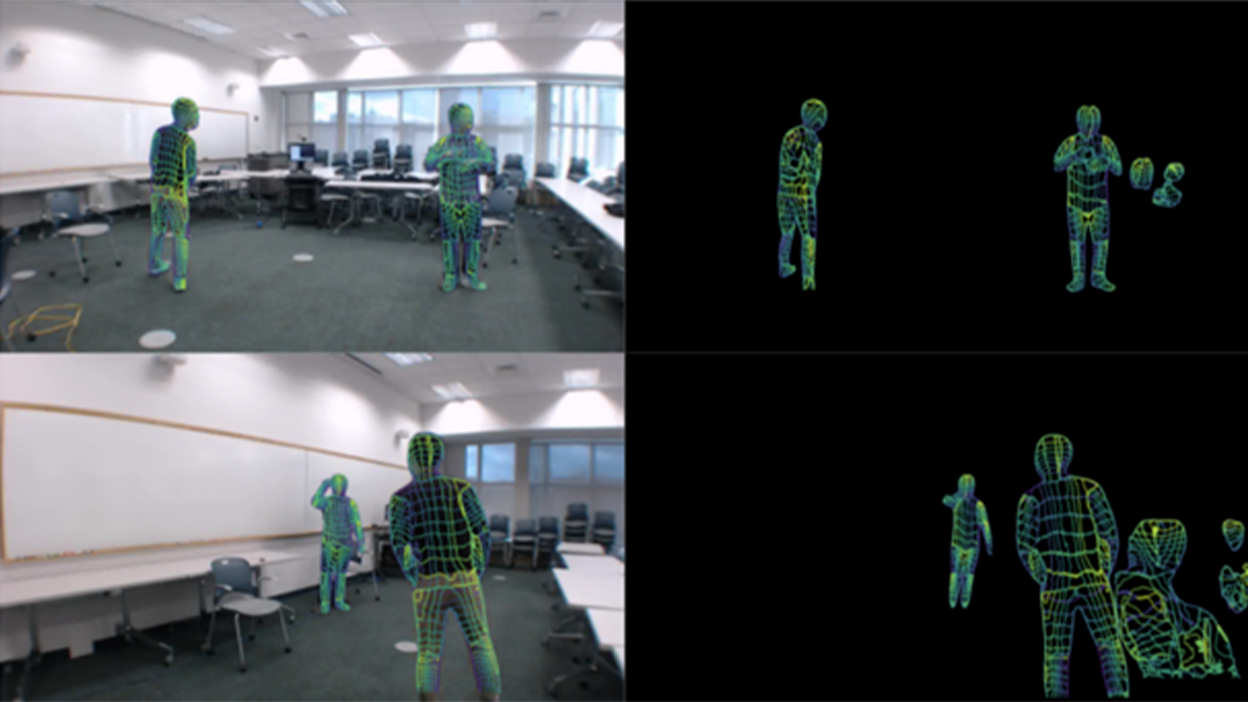
The capabilities demonstrated by most recent research in the field are incredible. WiFi sensing can detect whether a room is occupied with an accuracy exceeding 95%. It can count how many people are present and determine which rooms they are in. It can track movement with precision down to several centimeters, and can distinguish between activities such as walking, sitting, cooking, and sleeping. WiFi sensing can also monitor breathing rates, even through walls, and it can detect when someone has fallen, as illustrated in the Figure below.
A great example is the recent work from Carnegie Mellon University. Researchers there developed a system called "DensePose from WiFi" that uses artificial intelligence to reconstruct detailed human body poses, revealing not just presence but exactly how someone is standing or sitting, using only WiFi signals passing through walls. Their approach does not use cameras (Figure 2, right side) or wearables, just high-frequency sampling and very precise learning algorithms to transform WiFi radio waves into meaningful information.
To get to this point, the field has evolved at a remarkable pace, mirroring the same acceleration rate we have seen across computer science as artificial intelligence has matured and become more accessible. The foundational work emerged from MIT in 2013, when Professor Dina Katabi and her graduate student Fadel Adib (also currently an MIT Professor ) demonstrated a system called Wi-Vi that could detect humans moving behind walls using nothing but WiFi signals. This paper would later receive the ACM SIGMOBILE Test-of-Time Award for its lasting influence on the field.
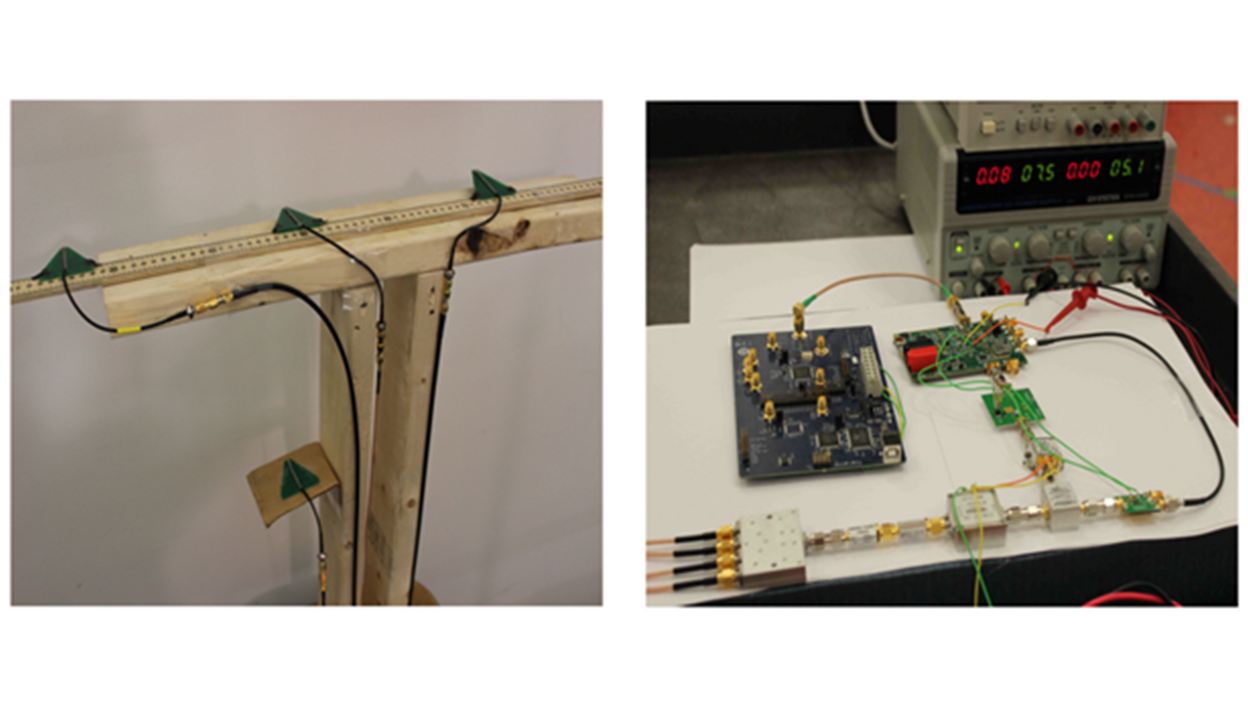
Their follow-up system, WiTrack, achieved three-dimensional motion tracking with an accuracy down to 10 to 20 centimeters, could detect falls with nearly 97% accuracy, and worked through walls and obstructions without requiring the tracked person to carry any device. The research was considered significant enough that Adib and Katabi were invited to demonstrate it to President Obama at the White House in 2015 (Figure below shows the WiTrack hardware).
Over the years, we have developed (correct) intuitions about surveillance, which are fairly reasonable because cameras require line of sight and microphones need to be within earshot. However, WiFi sensing operates differently. Radio waves pass through walls, and there is no lens to cover, no microphone to muffle, and no obvious device to find and disable.
The sensing happens passively, using signals that already permeate the environment. Your neighbour's WiFi network could, in principle, detect movement inside your apartment. A small device hidden in an adjacent room could monitor activity indefinitely. Someone standing outside your building might observe which rooms are occupied and what people are doing, all through the walls and without ever entering.
Security researchers distinguish between two types of threats. Active attacks require someone to access your network directly. But passive attacks are more subtle: an attacker simply receives and analyzes the WiFi signals already bouncing around your neighbourhood. No network access required, no digital trace is left behind. Thus, someone with the adequate equipment could determine when a home is empty, when occupants are asleep, whether a person lives alone. The laws of physics that govern radio wave propagation do not respect property lines or privacy expectations.
The simple answer is that individual defences are limited. Turning off WiFi is impractical for most people, and adding protective noise to WiFi transmissions has not yet seen broad implementation in consumer devices. A technique in this direction, known as jamming, is classified as war material in Switzerland and strictly forbidden for private use under the Telecommunications Act.
One hypothetical solution is to turn environments into Faraday cages, which are structures wrapped in conductive materials that block electromagnetic signals from passing through walls. This approach is also not straightforward: the same shielding that blocks external sensing also blocks your own signals from reaching emergency services or outdoor devices.
Given these limitations, the path forward lies less in individual action and more in collective awareness and policy. When acquiring a new router, consumers as of today have no way to know whether it includes sensing capabilities, as manufacturers are not required to disclose this. Privacy regulations have focused on cameras and microphones, the surveillance technologies we understand intuitively, while radio-frequency sensing has fallen into a regulatory gap. Addressing this will require recognising that surveillance no longer requires a lens or a microphone, and that it can happen through the same signals that carry our internet traffic, invisibly, continuously and without consent.
There is, however, one form of natural protection. Our current research has revealed something counterintuitive: in environments with many WiFi networks and devices, sensing actually becomes harder, not easier. Think of our lake example during a rainstorm: with so many overlapping ripples no single pattern can be easily traced. We call this the “dilution effect” when multiple devices speak simultaneously, creating several ripples in the signal, making it difficult for an observer without specialized hardware to extract coherent patterns, eventually providing a kind of natural camouflage.
The WiFi signals that deliver streaming video and video calls also create a constant, invisible map of presence and movement within every connected space. Each breath disturbs the electromagnetic field. Each step through a room creates patterns that can be read by anyone with the knowledge and equipment to do so.
The technology that seemed only a decade ago like science fiction is now being standardised by international bodies, deployed by major internet providers, and refined by artificial intelligence researchers who can reconstruct the human body through walls.
The question here is no longer whether this capability exists, because it clearly does. The question is who has access to read those ripples, and whether anyone will be required to ask permission first.
Our research group at the University of St.Gallen School of Computer Science develops distributed WiFi sensing systems for indoor monitoring applications such as occupancy detection and mental health awareness. This work has given us insight into how rapidly the field is advancing, and it is precisely these experiences that motivates a discussion about the privacy implications that accompany these capabilities. It is our responsibility to ensure that the public conversation keeps pace with the technology itself.
Article
A must read article in the MIT Technology Review and an overview on how this technology leaped from laboratories into consumer devices.

YouTube Video
A great TED talk by MIT Professor Dina Katabi explaining the physics and the healthcare potential to a general audience.

Book
A book by Shoshana Zuboff that provides a good view under a societal perspective to understand the how the passive collection of our behavioral data defines the privacy battle of our time. If you are short on time, jump straight into Chapter 8 ("Rendition: From Experience to Data") to see exactly how our physical, lived experiences are quietly appropriated and turned into digital power.