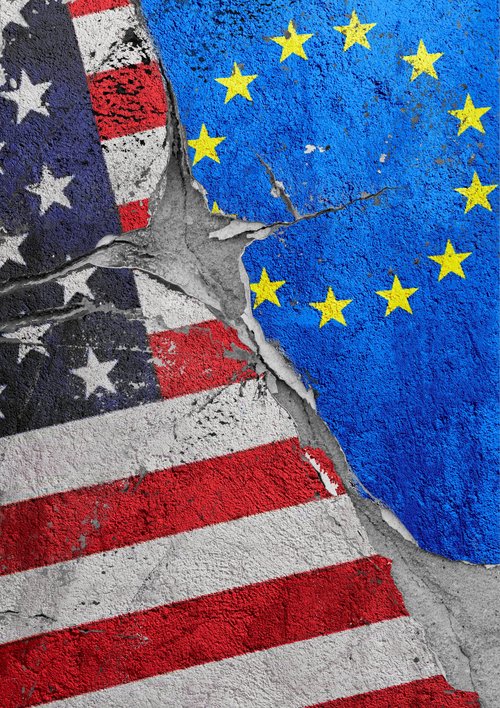
As global trade policy becomes increasingly protectionist, the threat of tariff retaliation looms large. This column analyses how the EU’s 2018 response to US steel and aluminium affected EU trade. It finds that strategic retaliation can successfully insulate the domestic economy from inflationary effects. However, even this type of retaliation leaves scars in bilateral trade relations, which did not recover even after the tariffs were suspended in 2022. Furthermore, larger retaliation packages increase the risk of price shocks for European producers and consumers.
Center for Economic Policy Research

Bilateral trade shocks may reallocate demand and competition across countries, creating spillovers for firms in bystander countries. To study how firms respond to trade shocks happening elsewhere, this column proposes a tractable trade model that allows trade elasticities to vary across destinations and incorporates external economies of scale. Applying the model to the universe of Italian firms, the authors find that the 2018–2019 US–China trade war generated an average export gain of 2.5%, but with substantial heterogeneity across firms. External economies of scale account for most of the variation in firm-level export performance.
Center for Economic Policy Research
In Südkorea gibt es Diskussionen und Bedenken hinsichtlich einer „KI-basierten Gesellschaft“ 12 Minuten
Heinrich Böll Stiftung

Governments with well-designed fiscal rules generally enjoy lower yields but less is known about whether investors price compliance with these rules. Using a panel of euro area member states over 1999–2025, this column finds that markets may be selective. Compliance with the deficit and the debt rule – observable, nominal, and unambiguous – is associated with lower sovereign bond yields. Results for other rules, involving more complex fiscal aggregates, are mixed. During financial stress, deficit and debt rule compliance compresses yields substantially. These findings carry a possible caution for the EU's 2024 fiscal reform, which pivots towards a medium-term expenditure-based framework.
Center for Economic Policy Research

Can Argentina’s Javier Milei evolve from disruptor to political leader? Expert comment LToremark 12 June 2026 Two and a half years after Milei came to power and shook up Argentina’s political system, the novelty might be wearing off. Since becoming Argentina’s president in December 2023, Javier Milei has defied political gravity. A self-described anarcho-capitalist with no prior executive experience, he came to power promising to upend decades of interventionist policies and slash public spending with his famous chainsaw. In doing so, he defeated the Peronist movement, long synonymous with Argentina’s political system but weakened by economic crisis and political dysfunction during Alberto Fernández’s presidency. The surprises did not stop there. Milei enacted one of the most ambitious fiscal adjustments in modern history, eliminating the fiscal deficit and restoring a budget surplus. He passed significant reforms and brought down triple-digit inflation despite controlling only a small minority in Congress. His success in the 2025 midterm elections strengthened his legislative position and paved the way for further reforms, including a major overhaul of labour regulations. In the process, he became an international celebrity and a reference point for the global libertarian right. Related work Argentines voted to dismantle Peronist patronage. Whether Milei can do that is uncertain Yet 2026 has served as a reminder that this is still Argentina – where there are no blank cheques. Milei’s approval ratings are down and signs of political fatigue are beginning to emerge, as many Argentinians continue to struggle despite improving macroeconomic indicators. Meanwhile, increasingly public disputes within the government are raising questions about Milei’s ability to manage his coalition and fuelling speculation about alternative candidates on the right. And Peronism may not be over either. Former president Cristina Fernández de Kirchner, whose political career appeared to be over after being convicted on corruption charges and placed under house arrest, is once again polling competitively – although she is unable to run for office. Despite Milei’s novelty, neither Peronism nor Argentina’s talent for political surprises have disappeared.The economic challengeIt would be hard even for Milei’s critics to deny his economic achievements. Inflation has come down from 211 per cent when he took office in December 2023 to just over 30 per cent last month. Although still among the highest rates in the world, it no longer dominates political debate in a society accustomed to much higher levels of inflation. The economy is expected to grow by 3.5 per cent this year, boosted by exports of shale oil and gas from the Vaca Muerta reserves, mining and agriculture. Argentina’s central bank has successfully defended the value of the peso, which remains broadly stable, and has begun to rebuild foreign currency reserves, one of the country’s most persistent economic vulnerabilities. Finally, despite his close political affinity with US President Donald Trump, Milei has moved to liberalize foreign trade, slashing export taxes and supporting the Mercosur-European Union free trade agreement. Related work Milei has taken a first step towards reshaping Argentina’s economy. There is a long, bumpy way to go But in September 2025, following his party’s defeat in the Buenos Aires provincial elections, market turbulence raised serious doubts about the sustainability of Milei’s programme prompting a direct intervention from the US Treasury to restore confidence. This served as a reminder that Argentina remains highly exposed to shifts in investor confidence and external financing conditions. While those fears have subsided somewhat, the country is still struggling to lower its sovereign risk premium and re-enter international debt markets, one of the government’s most important medium-term objectives. But stabilization and prosperity are not the same thing. Rightly or wrongly, many Argentinians feel they are not seeing the benefits of the economic turnaround. Real wages remain low, consumption has recovered unevenly and much of the recent growth has been concentrated in a handful of highly competitive export sectors like agriculture, mining, and oil and gas. Less competitive parts of the economy, including manufacturing, are struggling, while much of the new employment being created is either informal or concentrated in low-paying activities such as delivery services. The government is betting that lower inflation, deregulation and fiscal discipline will eventually unlock a broader wave of investment. Whether Argentinians are willing to wait for those promises to materialize is another matter.The political challengeThe end of his honeymoon period has also exposed Milei’s limitations as a political leader. While highly effective at setting direction, he has shown less interest in the day-to-day management of government outside the economy. Milei is fiercely loyal to his small circle of trusted advisors but seems unable to resolve the widening dispute between his sister and closest confidant Karina and his chief political strategist Santiago Caputo, fuelling perceptions of government infighting. He has also stood by his chief of staff, Manuel Adorni, despite a steady stream of corruption allegations that have dented Milei’s claim to have uprooted the political caste. Adorni’s recent admission that he underreported his taxes has only increased pressure on the president from opposition and government allies alike.Meanwhile, Peronism is once again viewed by many as a viable alternative, despite remaining divided and burdened by memories of its disastrous final years in office. Cristina Fernández de Kirchner’s influence over the movement remains considerable. The leading contender to inherit her mantle is Buenos Aires governor Axel Kicillof although their relationship is strained. Kicillof is closely associated with the interventionist economic model that Milei was elected to dismantle and would be a formidable candidate if Argentinians decide that Milei’s experiment needs to be reversed. Less so if voters conclude that the model broadly works but requires moderation.
Chatham House

Why has Albania’s Kushner controversy attracted such international attention? Expert comment jon.wallace 12 June 2026 Protests about plans for a luxury resort expose issues confronting all developing countries - over natural resources and sovereignty in an age of a triple planetary crisis. Last week, the streets of Tirana were filled with protesters brandishing inflatable flamingos. They had gathered in opposition to plans by President Donald Trump’s son-in-law, Jared Kushner, to develop a luxury resort on Albania’s largely unspoiled Sazan Island and the Zvërnec coastline near Vlora. The area is home to flamingos, more than 200 migratory bird species, Mediterranean monk seals and nesting sea turtles. The demonstrations lasted several days and spread internationally, with rallies reported in London and other European capitals.It may seem unusual that plans for a resort in a relatively remote part of Albania generated such protest and international attention. To some extent, the involvement of Kushner is to blame – as Albanian Prime Minister Edi Rama claimed when defending the project.But the protests, held under the slogan ‘Albania is not for sale’, speak to a broader question: how much of a country’s environment and natural heritage should be sacrificed in the name of economic growth? This question acquires new urgency in an era defined by the accelerating triple planetary crisis of climate change, biodiversity loss and pollution. Decisions about coastlines, forests and freshwater systems are no longer merely matters of domestic planning. They are increasingly tests of how governments reconcile development imperatives with ecological limits that are becoming harder to ignore.Thus, what might once have been treated as a routine foreign investment project has become a flashpoint for debates about sovereignty, environmental protection and geopolitical alignment.The government’s dilemmaFor Rama’s government, the attraction of such a project, which is also backed by Qatari as well as local investors, is evident. Albania has spent decades attempting to attract the kind of foreign direct investment that wealthier European states often take for granted. Controversial amendments to Albania’s law on protected areas in 2024 opened the door to tourism development, enabling further expansion of a sector that has already more than tripled in size over the past decade. Large-scale tourism developments promise employment, infrastructure upgrades, fiscal revenue and international visibility. In a competitive global environment, they also signal that a country is ‘open for business’. In this sense, the proposed development represents precisely the kind of transformative investment that many governments in the Global South and parts of Europe’s periphery compete to secure.Similar projects include large-scale coastal tourism projects in Egypt’s Red Sea region and major resort and infrastructure developments along Montenegro’s Adriatic coast. Both have been promoted as bringing jobs, foreign exchange and regional growth. In the case of Montenegro, EU accession is also a key aim. — Albanian Prime Minister Edi Rama in conversation at Chatham House in 2023. Yet the very characteristics that make Albania attractive to investors are the same ones that underpin domestic and international opposition. The country’s relatively undeveloped coastline, rich biodiversity and ecological heterogeneity are not simply aesthetic assets. They are functional ecosystems that support fisheries, protect against coastal erosion, store carbon, and underpin climate resilience in a region already experiencing rising temperatures, water stress and extreme weather events.In other words, what is at stake is not simply land use, but the integrity of critical ecological systems.Development, conservation and the triple planetary crisisAcross the Mediterranean and beyond, ecosystems are under mounting pressure from habitat fragmentation, marine degradation, pollution and climate-induced stress. Rising sea temperatures are altering marine biodiversity. Coastal erosion is accelerating due to both natural and human pressures. At the same time, demand for land, water and infrastructure continues to grow, driven by tourism, urbanization and global capital flows.The underlying question is no longer whether nature has economic value, but whether it can be converted into short-term financial gain without undermining the long-term ecological foundations on which that value depends.The geopolitical layerYet Albania’s dilemma cannot be understood through economics or environmental policy alone.The country occupies a strategically complex position. As a NATO member and a candidate for EU accession, it is embedded in Western security structures but outside the EU’s economic and regulatory framework. It is seeking deeper integration with Europe, while trying to maintain strong ties with the United States.This dual orientation embeds environmental governance within geopolitical dynamics, as access to investment, trade relationships and international credibility is increasingly shaped by how states manage – or not – climate risks, protect biodiversity and regulate the use of natural resources.At the same time, it complicates domestic debates about environmental governance and sovereignty over natural assets. The ‘flamingo revolution’ is a clear illustration; protesters have questioned the environmental implications of the development. But they are also unhappy about the transparency of the decision-making process, and the extent to which foreign investors influence Albania’s natural heritage. The dispute over a stretch of Albania’s coastline is therefore ultimately not about a single development project. It is about the evolution of the country’s development model under conditions of ecological constraint and geopolitical competition. It is also about who gets to decide how strategic natural assets are used, and in whose interest development is pursued. The critical challenge lies not in designing standards, but in ensuring they are applied rigorously and consistently. Economic growth, environmental protection and strategic alignment are all legitimate national objectives. The difficulty arises when pursuing one appears to undermine the others. This is the governing dilemma of the triple planetary crisis: environmental degradation is not a side effect of development, but a constraint on its long-term viability. The protesters are asking whether some places should remain beyond the reach of developers. The government is asking how a country can prosper if it turns away potentially transformative investment. Neither question is unreasonable. The challenge for Albania – and for many countries in similar positions – is that the answers now lie at the intersection of economics, ecology and geopolitics, where trade-offs are unavoidable and increasingly irreversible.
Chatham House