






Economies of Crime

Die neue Ausgabe des Universitätsmagazins HSG FOCUS widmet sich den vielschichtigen Schnittstellen von Wirtschaft, Recht und Kriminalität – von globalen Drogenmärkten über Alltagsfälschungen bis hin zu Bilanzbetrug und organisierter Kriminalität in der Schweiz. Die Beiträge zeigen, wie sehr illegale Praktiken auf legale Strukturen angewiesen sind – und wo Politik, Regulierung und Gesellschaft gefordert sind.​
«Zahlen und Fakten zur globalen Schattenwirtschaft»: Das Video von Daniel Sager bietet einen Überblick über Ausmass und geografische Aspekte der wichtigsten illegalen Märkte weltweit.
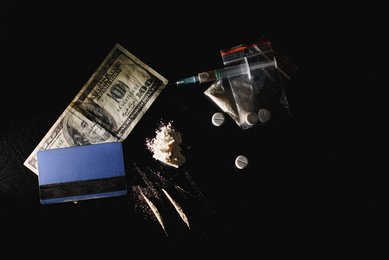
«Chemie und Technologie beflügeln den Drogenhandel»: Matías Dewey und Alvaro Pastor machen deutlich, wie eng der illegale Drogenhandel mit legalen Märkten verflochten ist. Chemikalien aus der globalen Industrie, unterschiedliche staatliche Regulierungen und digitale Technologien ermöglichen flexible, schwer kontrollierbare Wertschöpfungsketten. Vom Kokaanbau im peruanischen Amazonasgebiet bis zu verschlüsselten Messengern und digitalen Zahlungssystemen zeigt der Beitrag, dass illegale Ökonomien ohne legale Infrastrukturen nicht funktionieren – und warum Regulierung, Plattformkontrolle und staatliche Durchsetzung neu gedacht werden müssen.​
«Der Homo Oeconomicus in der Kriminalität»: Nora Markwalder fragt, ob Straftäter rational handeln. Sie erläutert rationale Kriminalitätstheorien, nach denen Täter Kosten und Nutzen abwägen und Gelegenheiten gezielt nutzen – ein Ansatz, der Prävention ermöglicht. Zugleich zeigt sie die Grenzen dieser Sicht auf: Viele Delikte entstehen ohne rationales Kalkül und sind stärker von sozialen oder psychischen Faktoren geprägt.
Markus Müller-Chen beleuchtet in seinem Artikel «Das Gucci-Täschlein und das grosse Geschäft mit gefälschter Ware» den milliardenschweren Handel mit Produktfälschungen. Hohe Originalpreise, Statusdenken, Online-Verfügbarkeit und täuschend echte «Superfakes» treiben die Nachfrage. Der Beitrag zeigt rechtliche Gegenmittel, aber auch die Risiken für Unternehmen, Arbeitsplätze und Käufer, die sich strafbar machen können.​
Unter dem Titel «Bilanzskandale: Es endet häufig hässlich, wenn man die Zahlen aufhübscht» analysiert Peter Leibfried die Gemeinsamkeiten hinter Fällen wie Wirecard, Enron oder Signa. Dabei zeigt sich, dass sich trotz Regulierung Muster wiederholen: überbewertete Vermögen, versteckte Schulden, falsche Konsolidierung. Oft beginnt es mit Druck und Grauzonen, nicht mit Vorsatz. Leibfried plädiert für bessere Ausbildung, ethisches Bewusstsein und den kritischen Umgang mit Finanzdaten.​
«Die Mafia ist überall. Sogar im Schrebergarten»: Henry Habegger zeigt, wie organisierte Kriminalität von liberalen Strukturen in der Schweiz profitiert. Milde Strafen, Föderalismus und Vollzugsdefizite schaffen Schlupflöcher. Erste Reformen deuten auf ein Umdenken hin – entscheidend bleibt jedoch die konsequente Durchsetzung.

Studie

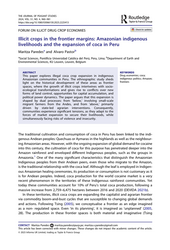
Maritza Paredes / Alvaro Pastor: Illicit crops in the frontier margins: Amazonian indigenous livelihoods and the expansion of coca in Peru (2023)

Die Ausweitung der Koka-Kokain-Märkte im Amazonasgebiet ist nicht allein auf Staatsversagen oder kriminelle Gruppen zurückzuführen. Dieser Artikel zeigt auf, wie langfristige Entwicklungsprojekte im Amazonasgebiet häufig zur Erschliessung neuer landwirtschaftlicher Gebiete, zu Ansiedlungen und zur Veränderung der Ökologie führen. Die unbeabsichtigten Folgen dieser staatlichen Entwicklungsprojekte sind die fortschreitende Verarmung der lokalen landwirtschaftlichen Gemeinschaften, die Verschlechterung der Bodenqualität und die Verschlechterung der Landbesitzverhältnisse. In diesem Szenario erweisen sich Kokapflanzen als die praktikabelste Option zur Sicherung des Lebensunterhalts, auch für indigene Völker.

Studie

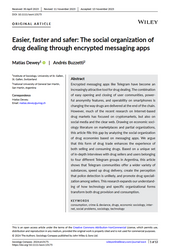
Matías Dewey / Andrés Buzzetti: Easier, Faster and Safer: The Social Organization of Drug Dealing through Encrypted Messaging Apps (2024)

Die Digitalisierung beschränkt sich nicht nur auf die legale Wirtschaft. Sie durchdringt auch illegale Märkte, macht den Austausch von Waren und Dienstleistungen einfacher und erschwert gleichzeitig Ermittlungen. Diese Studie zeigt beispielsweise, dass völlig legale Apps für den Verkauf von Drogen eingesetzt werden. Die Erfahrungen von Drogenverkäufern und -konsumenten sind eindeutig: Apps wie Telegram machen den Drogenhandel einfacher, schneller und sicherer. Dieser Artikel war der erste, der dieses Phänomen ans Licht brachte.

Webseite

Stop Piracy

Die Schweizer Plattform «Stop Piracy» bietet verlässliche, faktenbasierte Informationen zu Fälschungen und Piraterie und leistet damit einen wichtigen Beitrag zur Sensibilisierung der Öffentlichkeit. Besonders hilfreich sind die kompakten Merkblätter, die anschaulich zeigen, woran man Fälschungen und unseriöse Online-Anbieter erkennt. Wer sich nicht nur theoretisch, sondern auch praktisch mit dem Thema auseinandersetzen möchte, findet hier eine ausgezeichnete Anlaufstelle.

Buch

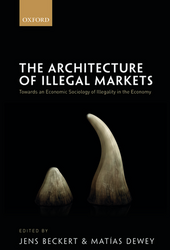
Jens Beckert / Matías Dewey: The Architecture of Illegal Markets. Towards an Economic Sociology of Illegality in the Economy (2017)

Wer verstehen will, wie illegale Märkte funktionieren – und nicht einfach davon ausgeht, dass sie lediglich eine Folge krimineller Organisationen oder gescheiterter Staaten sind –, bietet dieses Buch eine neue Perspektive auf schwer zu erforschende Wirtschaftssysteme. Es befasst sich mit zusätzlichen Elementen, die Wirtschaftssysteme ausserhalb des Gesetzes ausmachen, wie Kredite, Infrastruktur, soziale Akzeptanz und die Bedeutung von Waren. Es ist der erste ernsthafte Versuch, illegale Märkte aus soziologischer Perspektive zu konzeptualisieren, zu klassifizieren und zukünftige Forschungsrichtungen vorzuschlagen.

Film

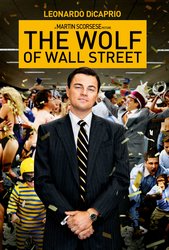
Martin Scorsese: The Wolf of Wall Street (2013)

Wer wissen möchte, wie Gelegenheiten Delikte begünstigen, dem sei der Film «The Wolf of Wall Street» empfohlen. Der Film basiert auf der Geschichte des Börsenmaklers Jordan Belfort und spielt in den 1980er und 1990er Jahren in New York. Tatort ist der kaum regulierte Markt für sogenannte «Pennystocks». Der Film zeigt auf, wie einfach Marktmanipulationen und der Betrug argloser Kundinnen und Kunden damals waren und wie gering die Chance, erwischt zu werden – vor allem, wenn man die Finanzaufsichtsbehörden in eisig gekühlte Büros einsperrt…

Buch

Christof Schürmann: Die Bilanztrickser – wie Unternehmen ihre Zahlen frisieren und den Anleger täuschen (2003)

Christof Schürmann hat als Journalist bei der WirtschafsWoche über viele Jahre die Berichterstattung von Unternehmen kritisch begleitet. Dabei schaut er nicht nur auf die allgemeine betriebs- und finanzwirtschaftliche Entwicklung, sondern setzt sich auch mit den dazugehörigen Fragen von Rechnungslegung und Bilanzierung auseinander. Er zeigt, wo Spielräume bestehen, und liefert Beispiele, wie diese genutzt werden.

Studie

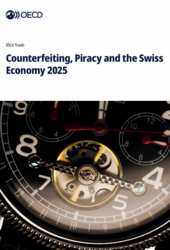
OECD: Counterfeiting, Piracy and the Swiss Economy 2025

Für eine zusätzlich ökonomische Perspektive: Die OECD-Studie beleuchtet die volkswirtschaftlichen Folgen von Fälschungen und Piraterie in der Schweiz. Sie zeigt, wie stark besonders exportorientierte Branchen wie die Uhren- oder Pharmaindustrie betroffen sind, und liefert aktuelle Daten zu Handelsrouten, Schadenssummen und globalen Zusammenhängen.

Fokussiert bleiben

Ausgewählte Feed-Beiträge von Universitäten, Denkfabriken und Medien.
11.01.2026
09.01.2026
The new threat? An imperial America
Politik

The new threat? An imperial America

The new threat? An imperial America 27 January 2026 — 4:00PM TO 5:00PM Anonymous (not verified) 9 January 2026 Chatham House and Online What President Trump’s foreign policy means for Europe, Russia and China. The implications of President Trump’s foreign policy means for Europe, Russia and China. President Trump’s second presidency poses a stark question: has the United States shifted from a reluctant hegemon to something resembling an imperial power?The administration’s foreign policy is characterised by transactional deal-making, disregard for international norms, indifference to traditional allies, and a willingness to use hard military power. The operation to capture Venezuelan President Nicolás Maduro brought these tendencies into sharp focus. For Europe, the implications are profound. This shift threatens not only the future of NATO and the European defence architecture that the United States underpins, but also raises direct concerns about territorial integrity, given explicit threats to annex Greenland, part of NATO ally Denmark.The Maduro operation underscored the administration’s readiness to deploy US forces to achieve foreign policy objectives. All loosely aligned around a hemispheric vision in which Washington dominates the Western Hemisphere. Countries outside Trump’s preferred orbit can not rely on American intervention. Those within it are proceeding with caution.For Russia and China, this posture presents both risks and opportunities. Moscow faces an unpredictable United States focused on leverage, seeking grand bargains backed by military power. Beijing, meanwhile, confronts a more openly confrontational America, prepared to weaponise tariffs, technology controls, and security partnerships across the Indo-Pacific.The result is a more brittle international order—one in which power is exercised bluntly, alliances are strained, and the risk of miscalculation steadily increases. A doctrine of ‘might makes right’.

Chatham House

07.01.2026
05.01.2026
04.01.2026
The US capture of President Nicolás Maduro – and attacks on Venezuela – have no justification in international law
Politik

The US capture of President Nicolás Maduro – and attacks on Venezuela – have no justification in international law

The US capture of President Nicolás Maduro – and attacks on Venezuela – have no justification in international law Expert comment jon.wallace 4 January 2026 This may be the moment when Western Europe realizes that the US has abandoned the core values that united them for the past century, writes the head of Chatham House’s International Law Programme. The capture of Venezuelan President Nicolás Maduro and his wife by US forces operating in Venezuela, and his forced transfer to the US for trial, poses a significant challenge for international law. The US has described the operation as a judicial ‘extraction mission’ undertaken by law enforcement operatives supported by the military. Yet this was a military operation of considerable scale, involving strikes on military targets in and around Caracas, the capital, and the forcible abduction of a sitting president by US special forces. It is clearly a significant violation of Venezuelan sovereignty and the UN Charter. This fact is compounded by President Donald Trump’s announcement during his press conference of 3 January that the US will ‘run’ Venezuela and administer a political transition, or regime change, under the threat of further, more massive uses of force. In addition, there seems to be a determination to use the threat of force to extract funds and resources in compensation for supposed ‘stolen’ or nationalized US assets and oil. Justifications are hard to seeIt is difficult to conceive of possible legal justifications for transporting Maduro to the US, or for the attacks. There is no UN Security Council mandate that might authorize force. Clearly, this was not an instance of a US act of self-defence triggered by a prior or ongoing armed attack by Venezuela.  The White House asserts that it is defending the American people from the devastating consequences of the illegal importation of drugs by ‘narco-terrorists’ – consequences that could be compared to an armed attack against the US. However, in international law, only a kinetic assault with military or similar means qualifies as a trigger for self-defence.‘Restoring democracy’This leaves the argument of pro-democratic intervention. Notably, the US did not use pro-democratic action as a formal legal justification when it invaded Grenada in 1983 and displaced its communist-leaning government. Neither did it do so when it invaded Panama in 1989 and captured President Manuel A. Noriega, with a view to putting him on trial for drugs offenses.Washington avoided doing so because it feared creating a precedent that would justify pro-democratic interventions by other countries which it might oppose. Instead, it relied on an unconvincing claim to self-defence.In the case of Venezuela, the US alleges that Maduro stole the presidential poll of 2024, that opposition candidate Edmundo Gonzales Urrutia was the true victor, and that Venezuelan authorities falsified the result of 2025’s parliamentary elections. While this is disputed, there is little doubt that the electoral process was deeply flawed.  Related work US to ‘run’ Venezuela after Maduro captured, says Trump: Early analysis from Chatham House experts In 1948 the UN Declaration on Human Rights first enunciated the doctrine that the authority of a government must be based in the will of its people. But in classical international practice, those who exercise effective control over a country’s population and territory will be treated as the government. Considerations of legal or political legitimacy matter less. Accordingly, most governments have abandoned the practice of formally recognizing newly established governments, however they come to power. If they are effective, they are the government. However, in the 1990s, with the end of the Cold War, the doctrine articulated by the UN Declaration on Human Rights gained in currency.In 1990, Jean-Bertrand Aristide was elected President of Haiti. But he was soon displaced in a coup mounted by a military junta. In 1994, after many failed diplomatic attempts to restore the democratic outcome of the elections, the UN Security Council formally authorized a US-led force to facilitate the departure of the generals. Faced with the imminent US invasion, they gave in and power was restored to Aristide.Since then, a whole clutch of coups in Africa were opposed by the Organization of African Unity (OAU) and its successor the African Union (AU), or sub-regional organizations. In several instances, these organizations authorized the use of force to restore democracy. Most recently, force was used to overturn the attempted coup in Benin last December with the backing of regional organizations.African institutions and governments have also used sanctions and threats of force, where an incumbent government refused to hand over power after having lost elections. However, these instances generally required a formal election result.This doctrine cannot be invoked in cases of creeping authoritarianism or in response to claims that elections have not been free and fair. It only applies in cases of counter-constitutional coups or where there is an election result that remains unimplemented by a sitting government. The doctrine is generally only applied where the UN Security Council, or at least a credible regional organization, has granted a mandate – to avoid individual states seeking regime change in pursuit of their own agendas. Clearly, in this instance, there was no mandate from the UN or the Organization of American States.The apparent wish of the US government to work through the former Vice President of the Maduro government, Delcy Rodriguez, and her cabinet and officials, rather than putting in place those who are broadly believed to have won the elections of 2024/5, undermines any argument of pro-democratic intervention.US courtsMr Maduro and his wife will find little comfort in the fact that they were removed from Venezuela by way of an internationally unlawful intervention. US courts consistently apply the so-called Ker-Frisbie doctrine, which holds that they will exercise jurisdiction, irrespective of the means by which the body of the defendant was procured for trial.The US will also refuse to extend Maduro the immunities that automatically apply to a serving president when travelling abroad. This too, is legally controversial. But as Noriega experienced before him, the US authorities are unlikely to be deterred by this fact.

Chatham House

31.12.2025
22.12.2025