Cybersecurity

Cybersecurity ist eine Voraussetzung digitaler Gesellschaften. Sie muss täglich gewährleistet werden, denn Cyberangriffe sind allgegenwärtig. Diese Ausgabe von HSG FOCUS beleuchtet diese zentralen digitalen Bedrohungen und zeigt mögliche Reaktionen auf.
Wie Prof. Guido Salvaneschi darlegt, ist Cyberkriminalität heute eine global organisierte Industrie mit eigenen Geschäftsmodellen, Service-Strukturen und starkem Wachstum. Ransomware gilt dabei als bevorzugtes Instrument, da sie skalierbar und profitabel ist. Wirksame Abwehr beginnt jedoch nicht bei teurer Technologie, sondern ganz grundlegend bei starken Passwörtern, Backups oder der Sensibilisierung von Mitarbeitenden.
Dabei verschärft künstliche Intelligenz die Lage zusätzlich. Sie automatisiert Angriffe, imitiert Stimmen und senkt Einstiegshürden. Gleichzeitig setzen Verteidiger sie zur Anomalieerkennung ein, wodurch ein dynamisches Wechselspiel zwischen Angriff und Abwehr entsteht.
Was geschieht, wenn ein Unternehmen erfolgreich angegriffen wird? Thomas Meier, CEO der InfoGuard AG, beschreibt im Interview solche Situationen als von nüchterner Geschäftslogik geprägt. Kriminelle Gruppen verstehen sich oft als Unternehmer. Entscheidend ist, wer das Verhandlungstempo kontrolliert und auch unter Druck einen kühlen Kopf bewahrt. Seine zentrale Botschaft: Cyberresilienz ist Chefsache und nicht delegierbar.
Einen bislang wenig beachteten Überwachungsvektor beleuchtet Prof. Bruno Rodrigues. Handelsübliche WLAN-Router können Menschen durch Wände hindurch erfassen – ohne Kamera oder Mikrofon. Diese als «Wi-Fi Sensing» bezeichnete Technologie ist seit 2024 kommerziell verfügbar. Daraus ergibt sich eine politische Kernfrage: Wer darf diese Signale nutzen?
Geht es um Cyberhygiene oder Cybersecurity, wenn Soziale Medien die Gesundheit Minderjähriger bedrohen? Australien, Frankreich und weitere Staaten setzen auf Verbote für Minderjährige. Ein Forschungsteam der HSG um Prof. Simon Mayer hält dagegen: Das eigentliche Problem sind nicht die Nutzerinnen und Nutzer, sondern die Algorithmen, die auf maximale Interaktion optimiert sind – mit nachweislich schädlichen Effekten für alle Altersgruppen. Ein pauschales Zugangsverbot behebt die strukturelle Ursache nicht; es verschiebt die Konfrontation lediglich auf einen späteren Zeitpunkt.
Der Videobericht von Daniel Sager zeichnet schliesslich die Entwicklung der Cybersecurity von der Enigma-Entschlüsselung im Zweiten Weltkrieg bis heute nach. Er zeigt: Mit jeder neuen Technologie muss digitale Selbstverteidigung neu erlernt werden.

Podcast

«Alpha Boys» (2025)

Der vierteilige SRF-Podcast «Alpha Boys» zeigt, wie junge Männer in den Sog der «Manosphere» geraten, in der Influencer wie Andrew Tate Millionen User erreichen. Die Serie führt tief in digitale Communities, in denen Selbstoptimierung und vermeintliche Stärke in Frauenhass und Gewaltaufrufe kippen.

Buch

Shoshana Zuboff: Das Zeitalter des Überwachungskapitalismus (2018)

Ein Buch, das aus gesellschaftlicher Perspektive zeigt, wie das passive Sammeln unserer Verhaltensdaten den Kampf um Privatsphäre prägt. Wenn du wenig Zeit hast, lies direkt Kapitel 8 („Rendition: From Experience to Data“), um zu verstehen, wie unsere realen Erfahrungen unbemerkt erfasst und in digitale Macht umgewandelt werden.

YouTube Video

Dina Katabi: A new way to monitor vital signals (that can see through walls) (2018)

Ein sehr guter TED-Talk, in dem die MIT-Professorin die physikalischen Grundlagen und das Potenzial von WiFi-Sensing für die Medizin erklärt. Klar und verständlich in der Präsentation.

Studie

World Happiness Report 2026

Der «World Happiness Report» ist die weltweit führende Studie zum Thema globales Wohlbefinden und dessen Steigerung. Er vereint Daten zum Wohlbefinden aus über 140 Ländern mit Analysen von weltweit führenden Forschenden verschiedener akademischer Disziplinen. Der Bericht zeigt, dass die Lebenszufriedenheit bei geringer Nutzung sozialer Medien am höchsten ist und mit zunehmender Nutzung sinkt. Dies geht aus Daten des Programms für internationale Schülerbewertung (PISA) hervor. Für die Studie wurden sieben Internetaktivitäten von 15-jährigen Schülern in 47 Ländern erfasst.

Artikel

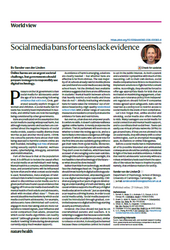
Sander van der Linden: Social media bans for teens lack evidence (2026)

In seinem in «Nature Health» veröffentlichten Artikel argumentiert Sander van der Linden, dass digitale Gefahren eine grosse gesellschaftliche Herausforderung darstellen. Er betont zudem, dass Regierungen Jugendliche darauf vorbereiten müssen, digitale Technologien verantwortungsbewusst zu nutzen.

Artikel

Meg Duff: How Wi-Fi sensing became usable tech (2024)

Ein unbedingt lesenswerter Artikel in der MIT Technology Review und ein Überblick darüber, wie sich diese Technologie von Laboren zu Alltagsgeräten entwickelt hat.

Artikel

Jean-Yves Marion: Ransomware: Extortion Is My Business (2025)

Ransomware-Angriffe sind ein professionelles Erpressungsgeschäft und nicht nur eine technische Cyberbedrohung. Anhand realer Vorfälle und aktueller Forschungsergebnisse zeigt dieser Artikel auf, wie Angreifer sich organisieren, verhandeln und ihre Opfer unter Druck setzen, damit diese Lösegeld zahlen. Es ist eine leicht verständliche und aufschlussreiche Lektüre für alle, die verstehen möchten, was die heutige Ransomware-Welle wirklich antreibt.

Artikel

Kris Oosthoek / Jack Cable / Georgios Smaragdakis: A Tale of Two Markets: Investigating the Ransomware Payments Economy (2023)

Die Autoren dieses zeigen auf, wie sich Ransomware-Angriffe tatsächlich auszahlen, indem sie die Geldflüsse verfolgen. Anhand von Tausenden realer Transaktionen werden zwei unterschiedliche Vorgehensweisen aufgezeigt: einfache, serienmässige Angriffe und hochprofessionelle «Ransomware-as-a-Service»-Operationen, die beide ihre eigene Geschäftslogik und ihre eigenen Anreize haben. Indem der Artikel nachverfolgt, wie Kryptowährungszahlungen über Zwischenhändler geleitet wer-den, vermittelt er den Lesern ein klares und verständliches Bild der Ransomware-Wirtschaft.

Buch

Chris Voss: Never Split the Difference: Negotiating As If Your Life Depended On It (2016)

Absolutes Must zu diesem Thema. Internationaler Bestseller mit praxiserprobtem Ansatz für Verhandlungen. Besonders lesenswert, weil: praxisnahe Techniken, psychologischer Ansatz, spannende Stories, vielfältige Anwendbarkeit.

Podcast

SRF Digital Podcast: «Ransomware-Negotiator» (2024)

Interessante Einblicke in die Verhandlungsführung mit Cyberkriminellen inklusive Insights von einem unseren absoluten Top-Cracks.

YouTube Video

Doku NZZ Format: «Ransomware-Angriff: Firmen in Geiselhaft von Cyberkriminellen» (2026)

Die Doku zeigt anhand Beispielen aus der Praxis eindrücklich, wie Ransomware-Angriffe heute ablaufen und weshalb sie für viele Unternehmen eine existenzielle Bedrohung darstellen.

Fokussiert bleiben

Ausgewählte Feed-Beiträge von Universitäten, Denkfabriken und Medien.
Gestern
16.06.2026
15.06.2026
12.06.2026
Can Argentina’s Javier Milei evolve from disruptor to political leader?
Politik

Can Argentina’s Javier Milei evolve from disruptor to political leader?

Can Argentina’s Javier Milei evolve from disruptor to political leader? Expert comment LToremark 12 June 2026 Two and a half years after Milei came to power and shook up Argentina’s political system, the novelty might be wearing off. Since becoming Argentina’s president in December 2023, Javier Milei has defied political gravity. A self-described anarcho-capitalist with no prior executive experience, he came to power promising to upend decades of interventionist policies and slash public spending with his famous chainsaw. In doing so, he defeated the Peronist movement, long synonymous with Argentina’s political system but weakened by economic crisis and political dysfunction during Alberto Fernández’s presidency. The surprises did not stop there. Milei enacted one of the most ambitious fiscal adjustments in modern history, eliminating the fiscal deficit and restoring a budget surplus. He passed significant reforms and brought down triple-digit inflation despite controlling only a small minority in Congress. His success in the 2025 midterm elections strengthened his legislative position and paved the way for further reforms, including a major overhaul of labour regulations. In the process, he became an international celebrity and a reference point for the global libertarian right. Related work Argentines voted to dismantle Peronist patronage. Whether Milei can do that is uncertain Yet 2026 has served as a reminder that this is still Argentina – where there are no blank cheques. Milei’s approval ratings are down and signs of political fatigue are beginning to emerge, as many Argentinians continue to struggle despite improving macroeconomic indicators. Meanwhile, increasingly public disputes within the government are raising questions about Milei’s ability to manage his coalition and fuelling speculation about alternative candidates on the right. And Peronism may not be over either. Former president Cristina Fernández de Kirchner, whose political career appeared to be over after being convicted on corruption charges and placed under house arrest, is once again polling competitively – although she is unable to run for office. Despite Milei’s novelty, neither Peronism nor Argentina’s talent for political surprises have disappeared.The economic challengeIt would be hard even for Milei’s critics to deny his economic achievements. Inflation has come down from 211 per cent when he took office in December 2023 to just over 30 per cent last month. Although still among the highest rates in the world, it no longer dominates political debate in a society accustomed to much higher levels of inflation. The economy is expected to grow by 3.5 per cent this year, boosted by exports of shale oil and gas from the Vaca Muerta reserves, mining and agriculture. Argentina’s central bank has successfully defended the value of the peso, which remains broadly stable, and has begun to rebuild foreign currency reserves, one of the country’s most persistent economic vulnerabilities. Finally, despite his close political affinity with US President Donald Trump, Milei has moved to liberalize foreign trade, slashing export taxes and supporting the Mercosur-European Union free trade agreement.  Related work Milei has taken a first step towards reshaping Argentina’s economy. There is a long, bumpy way to go But in September 2025, following his party’s defeat in the Buenos Aires provincial elections, market turbulence raised serious doubts about the sustainability of Milei’s programme prompting a direct intervention from the US Treasury to restore confidence. This served as a reminder that Argentina remains highly exposed to shifts in investor confidence and external financing conditions. While those fears have subsided somewhat, the country is still struggling to lower its sovereign risk premium and re-enter international debt markets, one of the government’s most important medium-term objectives. But stabilization and prosperity are not the same thing. Rightly or wrongly, many Argentinians feel they are not seeing the benefits of the economic turnaround. Real wages remain low, consumption has recovered unevenly and much of the recent growth has been concentrated in a handful of highly competitive export sectors like agriculture, mining, and oil and gas. Less competitive parts of the economy, including manufacturing, are struggling, while much of the new employment being created is either informal or concentrated in low-paying activities such as delivery services. The government is betting that lower inflation, deregulation and fiscal discipline will eventually unlock a broader wave of investment. Whether Argentinians are willing to wait for those promises to materialize is another matter.The political challengeThe end of his honeymoon period has also exposed Milei’s limitations as a political leader. While highly effective at setting direction, he has shown less interest in the day-to-day management of government outside the economy. Milei is fiercely loyal to his small circle of trusted advisors but seems unable to resolve the widening dispute between his sister and closest confidant Karina and his chief political strategist Santiago Caputo, fuelling perceptions of government infighting. He has also stood by his chief of staff, Manuel Adorni, despite a steady stream of corruption allegations that have dented Milei’s claim to have uprooted the political caste. Adorni’s recent admission that he underreported his taxes has only increased pressure on the president from opposition and government allies alike.Meanwhile, Peronism is once again viewed by many as a viable alternative, despite remaining divided and burdened by memories of its disastrous final years in office. Cristina Fernández de Kirchner’s influence over the movement remains considerable. The leading contender to inherit her mantle is Buenos Aires governor Axel Kicillof although their relationship is strained. Kicillof is closely associated with the interventionist economic model that Milei was elected to dismantle and would be a formidable candidate if Argentinians decide that Milei’s experiment needs to be reversed. Less so if voters conclude that the model broadly works but requires moderation. 

Chatham House

Why has Albania’s Kushner controversy attracted such international attention?
Politik

Why has Albania’s Kushner controversy attracted such international attention?

Why has Albania’s Kushner controversy attracted such international attention? Expert comment jon.wallace 12 June 2026 Protests about plans for a luxury resort expose issues confronting all developing countries - over natural resources and sovereignty in an age of a triple planetary crisis.  Last week, the streets of Tirana were filled with protesters brandishing inflatable flamingos. They had gathered in opposition to plans by President Donald Trump’s son-in-law, Jared Kushner, to develop a luxury resort on Albania’s largely unspoiled Sazan Island and the Zvërnec coastline near Vlora. The area is home to flamingos, more than 200 migratory bird species, Mediterranean monk seals and nesting sea turtles. The demonstrations lasted several days and spread internationally, with rallies reported in London and other European capitals.It may seem unusual that plans for a resort in a relatively remote part of Albania generated such protest and international attention. To some extent, the involvement of Kushner is to blame – as Albanian Prime Minister Edi Rama claimed when defending the project.But the protests, held under the slogan ‘Albania is not for sale’, speak to a broader question: how much of a country’s environment and natural heritage should be sacrificed in the name of economic growth? This question acquires new urgency in an era defined by the accelerating triple planetary crisis of climate change, biodiversity loss and pollution. Decisions about coastlines, forests and freshwater systems are no longer merely matters of domestic planning. They are increasingly tests of how governments reconcile development imperatives with ecological limits that are becoming harder to ignore.Thus, what might once have been treated as a routine foreign investment project has become a flashpoint for debates about sovereignty, environmental protection and geopolitical alignment.The government’s dilemmaFor Rama’s government, the attraction of such a project, which is also backed by Qatari as well as local investors, is evident. Albania has spent decades attempting to attract the kind of foreign direct investment that wealthier European states often take for granted. Controversial amendments to Albania’s law on protected areas in 2024 opened the door to tourism development, enabling further expansion of a sector that has already more than tripled in size over the past decade. Large-scale tourism developments promise employment, infrastructure upgrades, fiscal revenue and international visibility. In a competitive global environment, they also signal that a country is ‘open for business’. In this sense, the proposed development represents precisely the kind of transformative investment that many governments in the Global South and parts of Europe’s periphery compete to secure.Similar projects include large-scale coastal tourism projects in Egypt’s Red Sea region and major resort and infrastructure developments along Montenegro’s Adriatic coast. Both have been promoted as bringing jobs, foreign exchange and regional growth. In the case of Montenegro, EU accession is also a key aim. — Albanian Prime Minister Edi Rama in conversation at Chatham House in 2023. Yet the very characteristics that make Albania attractive to investors are the same ones that underpin domestic and international opposition. The country’s relatively undeveloped coastline, rich biodiversity and ecological heterogeneity are not simply aesthetic assets. They are functional ecosystems that support fisheries, protect against coastal erosion, store carbon, and underpin climate resilience in a region already experiencing rising temperatures, water stress and extreme weather events.In other words, what is at stake is not simply land use, but the integrity of critical ecological systems.Development, conservation and the triple planetary crisisAcross the Mediterranean and beyond, ecosystems are under mounting pressure from habitat fragmentation, marine degradation, pollution and climate-induced stress. Rising sea temperatures are altering marine biodiversity. Coastal erosion is accelerating due to both natural and human pressures. At the same time, demand for land, water and infrastructure continues to grow, driven by tourism, urbanization and global capital flows.The underlying question is no longer whether nature has economic value, but whether it can be converted into short-term financial gain without undermining the long-term ecological foundations on which that value depends.The geopolitical layerYet Albania’s dilemma cannot be understood through economics or environmental policy alone.The country occupies a strategically complex position. As a NATO member and a candidate for EU accession, it is embedded in Western security structures but outside the EU’s economic and regulatory framework. It is seeking deeper integration with Europe, while trying to maintain strong ties with the United States.This dual orientation embeds environmental governance within geopolitical dynamics, as access to investment, trade relationships and international credibility is increasingly shaped by how states manage – or not – climate risks, protect biodiversity and regulate the use of natural resources.At the same time, it complicates domestic debates about environmental governance and sovereignty over natural assets. The ‘flamingo revolution’ is a clear illustration; protesters have questioned the environmental implications of the development. But they are also unhappy about the transparency of the decision-making process, and the extent to which foreign investors influence Albania’s natural heritage. The dispute over a stretch of Albania’s coastline is therefore ultimately not about a single development project. It is about the evolution of the country’s development model under conditions of ecological constraint and geopolitical competition. It is also about who gets to decide how strategic natural assets are used, and in whose interest development is pursued. The critical challenge lies not in designing standards, but in ensuring they are applied rigorously and consistently. Economic growth, environmental protection and strategic alignment are all legitimate national objectives. The difficulty arises when pursuing one appears to undermine the others. This is the governing dilemma of the triple planetary crisis: environmental degradation is not a side effect of development, but a constraint on its long-term viability. The protesters are asking whether some places should remain beyond the reach of developers. The government is asking how a country can prosper if it turns away potentially transformative investment. Neither question is unreasonable. The challenge for Albania – and for many countries in similar positions – is that the answers now lie at the intersection of economics, ecology and geopolitics, where trade-offs are unavoidable and increasingly irreversible.

Chatham House

11.06.2026
South Asia’s Gen Z revolutions now face difficult realities
Gesellschaft

South Asia’s Gen Z revolutions now face difficult realities

South Asia’s Gen Z revolutions now face difficult realities Expert comment thilton.drupal 11 June 2026 New governments in Bangladesh, Nepal and Sri Lanka have popular mandates for change. But governance is proving challenging. Bangladesh, Nepal and Sri Lanka find themselves at a turning point. Their relatively new governments, brought to power in the wake of youth-led protest movements, retain popular mandates. But they must now grapple with governance challenges exacerbated by the Iran war and complicated relations with India.Similarities and differencesIn 2022, the government of Sri Lanka’s President Gotabaya Rajapaksa was overthrown in a mass protest movement known as the Aragalaya (‘Struggle’). Bangladesh’s ‘Monsoon Revolution’ followed in 2024, with long-serving Prime Minister Sheikh Hasina removed from power, before the so-called ‘Gen Z revolution’ in Nepal toppled Prime Minister KP Sharma Oli’s government in 2025.These movements were all fuelled by a combination of economic distress (all three countries are undergoing IMF bailouts), demographic pressures and political dysfunction, with growing resentment against ruling elites due to a culture of corruption, nepotism and increasingly autocratic tendencies. Social media also played an important role and allowed anti-establishment narratives to flourish.There are undoubtedly some country-specific differences. In Sri Lanka, the Aragalaya was triggered by a sovereign debt crisis, hyperinflation and commodity shortages. In Bangladesh, the issue of public sector job quotas for families of war veterans became a lightning rod for anti-government unrest. In Nepal, the catalyst was a social media ban.The elections that followed also took different trajectories. While Nepal chose radical change – electing a former rapper, Balendra Shah, as its new prime minister in March – Bangladesh opted for a degree of continuity in electing Tarique Rehman, the son of a former prime minister and president, from the established Bangladesh Nationalist Party (BNP). And while Nepal rejected established left-leaning political parties, Sri Lanka’s President Anura Kumara Dissanayake heads a coalition led by a Marxist-Leninist party, Janatha Vimukthi Peramuna (JVP).After the revolutionsDuring a recent visit to the region, it was clear that despite optimism, all three countries now face similar internal and external challenges.A climate of hope and belief in a fresh start persists. The new governments all came to power with large electoral mandates, creating a sense of opportunity. Even in Bangladesh, where there has been a degree of continuity, the proposed political reforms of the July National Charter have fuelled a sense of democratic renewal.However, initial euphoria is also giving way to a feeling that governments are squandering their goodwill through their inability or unwillingness to implement necessary reforms. These doubts are not helped by missteps stemming from the new governments’ inexperience. Related work Bangladesh election reveals a transformed political landscape In Nepal, despite Shah campaigning on an anti-corruption platform, two ministers in the new government departed within its first month after facing scandals. In Sri Lanka, growing frustration over austerity measures was exacerbated by the government response to Cyclone Ditwah last year, which some consider inadequate. Earlier in the year, the ruling party’s vote share dropped in local elections.In Bangladesh, violent crime is a growing concern as the army returns to the barracks after the February election. There are also concerns that the BNP government may only implement parts of the proposed July Charter political reforms to avoid changes that could erode its power. The party will face its first test when Bangladesh holds local government elections later this year.Stability not guaranteedStrong mandates therefore do not guarantee stability. This is particularly true if broader societal challenges are not addressed.All three countries have a history of prolonged periods of violence and instability. Nepal, which was plagued by a decade-long Maoist insurgency, has various social divides, including along caste, generational, regional and ideological lines. A constitution passed in 2015 sought to address these cleavages. However, there are fears that social cohesion could be undermined by the new government’s focus on appeasing its younger urban voter base, which could risk overlooking other constituencies. Strong mandates therefore do not guarantee stability. In Sri Lanka, the government has sought to separate itself from ethnic-based politics. But following the decades-long civil war, ethnic Sinhalese Buddhist nationalism remains entrenched in Sri Lankan society. This holds implications for lasting reconciliation with the country’s minority Hindu and Muslim Tamil community.Meanwhile, in Bangladesh the main divide is between the country’s two long-established dynastic political parties – the BNP and Awami League – with efforts to forge a credible youth-led ‘third front’ failing to bear fruit in the election. For now, this rivalry has been deferred by the ban on the Awami League. However, this situation is unsustainable; it will eventually be necessary to rehabilitate the party in some form to break the cycle of revenge politics that has historically plagued the country.The Iran war and India relationsThese pressures are exacerbated by the ongoing war in Iran. All three countries have been severely impacted by the war with inflationary pressures, fuel rationing and limited fiscal space to withstand the economic shocks of the conflict. They are also all heavily dependent on foreign remittances from Gulf states. These economic strains have cut short any post-election honeymoon period.Relations with India present another challenge. Governments in all three countries are seeking a reset in relations with New Delhi, which had been strained under their predecessors.India is a crucial source of humanitarian aid, development assistance and infrastructure investment to all three countries. The Iran war has also created space for greater alignment, given that New Delhi has stepped up energy exports to its neighbours as they face shortages.However, India’s prominence in the region also breeds mistrust from its neighbours, who face challenges in managing relations with their larger neighbour.The recent victory of Prime Minister Narendra Modi’s Bharatiya Janata Party (BJP) in the state election in West Bengal – which borders Bangladesh – is a mixed blessing for India-Bangladesh relations. On the one hand, it is expected to improve coordination between New Delhi and West Bengal, which could be crucial for the renewal of the India-Bangladesh Ganga water sharing treaty that is due to expire in December.However, with the BJP or its partners now ruling in four of five states bordering Bangladesh, there is also an increased risk of the party’s sometimes divisive identity-based politics souring relations with Bangladesh; border tensions recently flared after the BJP ordered a crackdown on undocumented immigrants. Related work India wants to reset relations after Bangladesh elections. It will be easier said than done In Nepal, Prime Minister Shah’s unpredictable leadership style has introduced a degree of uncertainty to relations, as seen in his refusal to meet India’s foreign secretary and the recent flare up of a territorial dispute. The BJP recently hosted Nepal’s ruling Rastriya Swatantra Party (RSP) and has sought to emphasize shared cultural ties, although this also risks fuelling fissures within Nepal. 

Chatham House