






News

Article

“Behold, the Nikola One in motion.” That was the title of a promotional video released by the American startup Nikola in 2018. It showed a hydrogen-electric semi-truck gliding silently and boldly down a country road, seemingly ready for consumers. On September 10, 2020, Hindenburg Research published a report featuring recorded phone calls, internal emails, and photographic evidence. As a short seller, the research firm profited from falling stock prices, including those of Nikola. Accordingly, it cast broad doubt on the startup’s credibility. In the media, one detail became a symbol of the fraud: The Nikola truck wasn’t driving. It was rolling. It had been towed up a hill; gravity did the rest. What followed was a crash.
Their fall was steep. In June 2020, Nikola had gone public on the Nasdaq via a SPAC merger and was at times valued higher than Ford, even though the company generated virtually no revenue. Two days before the Hindenburg Report, General Motors (GM) had announced a partnership. Ten days after the report, Nikola founder Trevor Milton resigned. In December 2023, he was sentenced to four years in prison for securities and wire fraud and in March 2025, US President Trump pardoned him. Nikola itself filed for Chapter 11 bankruptcy protection in February 2025.
More intriguing than the fraud, however, are the questions that preceded it: Why was Nikola’s communication so good for so long? And where exactly did it go wrong?
The case is American and was exacerbated by the pace of a SPAC IPO. When a company raises money for something that doesn’t yet exist, plausibility takes the place of due diligence. This applies to the seed round of a Zurich-based deep-tech startup just as much as it does to a Nasdaq listing.
Traditional valuation methods are of little use for young growth companies because reliable data series are still lacking. Investors must rely on soft indicators: prototypes, high-profile partnerships, or pre-orders. Only a plausible narrative turns these signals into tangible value. Financial economist Aswath Damodaran describes this as the interplay of “narrative and numbers,” a progression from the possible, through the plausible, to the probable.
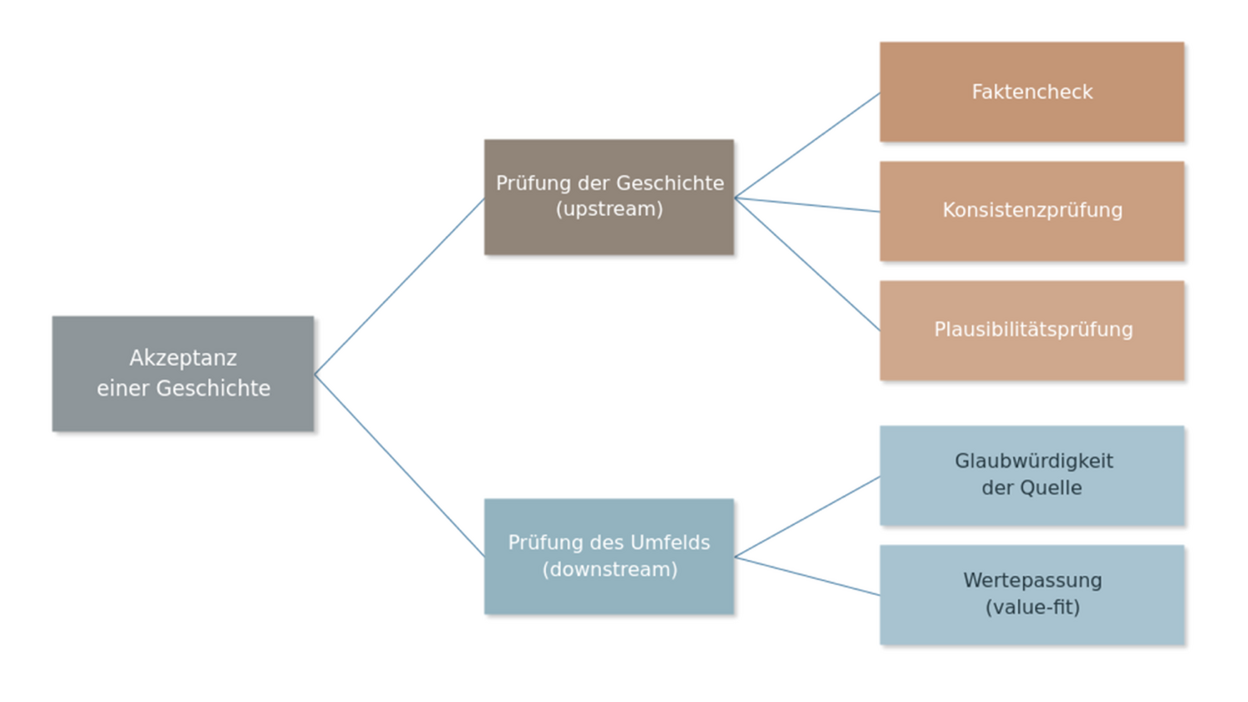
In this way, a story becomes something it was long forbidden to be in theory: an argument. Walter Fisher laid the foundation for interpreting stories as arguments with the concept pair “coherence and fidelity”: Does the story hold together internally? And does it align with what the audience perceives as true? The analysis of the Nikola case breaks this down into five steps across two levels—three for the story itself and two for its context:
Here, the facts, internal consistency, and plausibility of the story are up for debate. Yet it is precisely at this point that the double-edged nature of a wealth of detail becomes apparent. Precision makes a narrative verifiable and builds trust. But those who become too specific simultaneously provide ammunition for their own retraction.
Because hard evidence is lacking, the focus shifts to the message and its context. Is the source credible? And does the moral of the story align with the audience’s values (value fit)? Where numbers are absent, this alignment determines the acceptance of the entire story.
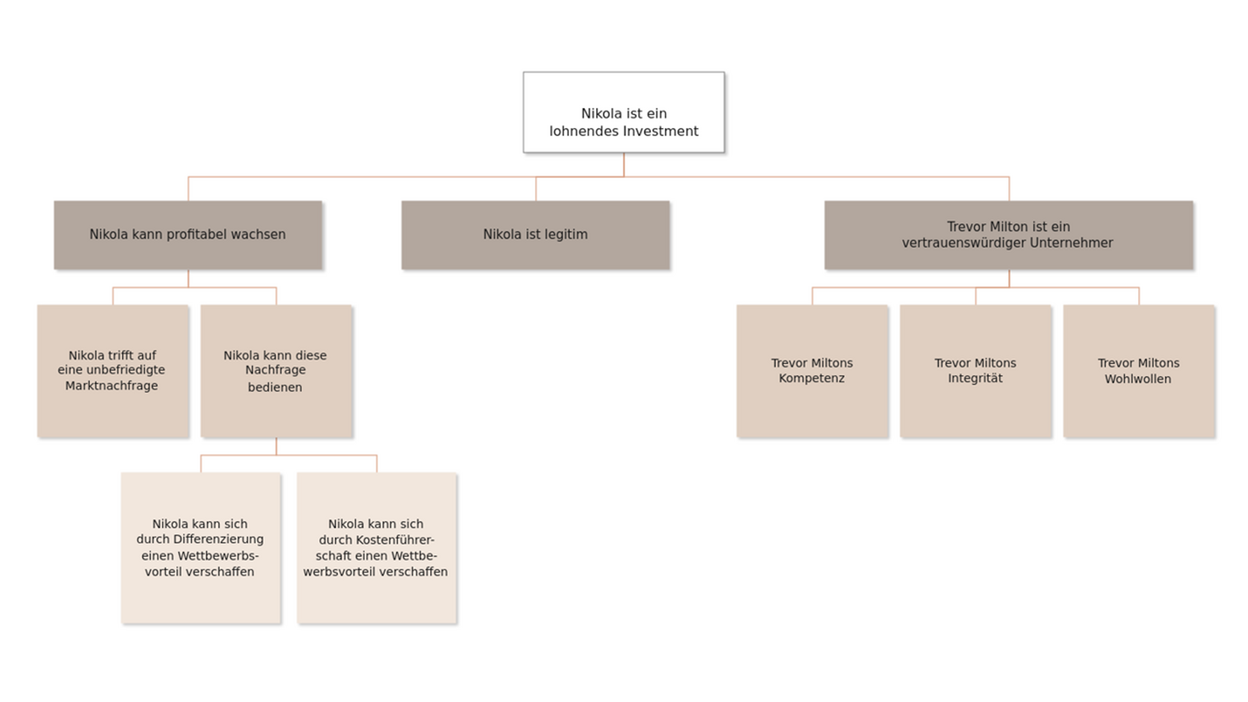
Analysis of Nikolas’s investor communications encompasses 112 announcements for the media between May 2016 and December 2021, as well as stock exchange filings, 279 media articles, and several interviews. The details of these communications reveal a recurring structure. The claim “This is a worthwhile investment” rests on three pillars: a viable business model, the company’s legitimacy within its environment, and the ethos of the founder. Ethos itself is threefold: perceived competence, integrity, and benevolence—the three dimensions of the trust model developed by Roger Mayer et al. It is crucial that all three pillars are strong. If even one is missing, the entire claim collapses, because anyone who no longer trusts one of them will no longer scrutinize the others.
Milton drew on all three pillars. He shaped the third—ethos—primarily through small biographical stories that he sprinkled throughout interviews and social media posts over the years: the high school dropout who made it to the top; his time as a missionary in Brazil, which provided him with teaching on selflessness; the battle against the old guard of the trucking industry. These fragments are effective because they tap into narrative patterns in the collective memory, such as David versus Goliath. Joseph Campbell summarized such patterns as the hero’s journey. But the story of clean heavy-duty transportation also struck exactly the right chord with the market. Financial analysts rewarded this resonance with optimistic price targets.
Verbally anticipating future states is part of the standard repertoire of corporate communication. Speaking in the present tense about a future that does not yet exist does not necessarily constitute deception. It mobilizes capital and secures partners. Moreover, such narratives can materialize on their own. The alliances they generate turn a claim into a fact in retrospect. A company can grow into its own prophecy. The partnership with General Motors announced on September 8, 2020, opened such a window of opportunity—one that the Hindenburg Report closed two days later.
Things get critical when imagery enters the picture. Nikola paired phrases like “has built the truck of the future” with high-quality images. A “We will build” became a demonstrated “It runs.” This shifts the burden of proof: It is not the company’s responsibility to show that the truck runs. The skeptic must prove that it does not. The blurring of the future, present, and past tenses further obscures the line between planning and execution.
Psychology has a term for this long-term effect: confabulation. Aswath Damodaran has described it in the context of the financial world. Founders who invent an improbable rise from poverty, or executives who recount battles against non-existent challenges, eventually begin to believe their own stories through constant repetition. Narratives become memories, and memories become narrative truths.
Objectively speaking, the video was irrelevant. By the time the Hindenburg Report was published, it was already more than two and a half years old. The real crux of the business model lay in the claim that the cost of one kilogram of hydrogen had been reduced from $16 to under $3. The entire vertically integrated value chain hinged on this single figure. In February 2021, Nikola stated to the SEC that this claim had been “inaccurate in whole or in part.”
However, identifying this weak point would have required an examination of the business model, not an examination of the video. That is precisely the teaching for investors.
After Milton’s resignation, a communication vacuum emerged. Nikola’s crisis communication shifted to a purely argumentative, defensive mode and got lost in questions of definition—such as the term “pusher” for a demonstration vehicle without its own propulsion. Above all, however, there was no figure around whom new narratives could have developed. With Steve Girsky, the former GM vice president, a credible, good-connected manager did take over as chairman of the board. A turnaround narrative centered around him never materialized.
Anyone who, in a crisis, discards the very tool that fuelled their rise will have nothing left with which to reach their stakeholders. The task is not to do away with storytelling, but to make it robust in its reasoning.
Dr. Marius Born is a teacher at the Institute for Applied Media Studies at ZHAW, where he heads the journalism specialization, and a lecturer at the University of St.Gallen. Through Born Media, he advises executives and startups on their communicative positioning. This report is based on his open-access monograph “Building Trust in Startup Communication” (Springer Nature 2024).
Book
The full version of this article. The book systematically reconstructs the Nikola case and develops a framework for analysing the interplay of argumentation and narrative. Chapter 8.5 lists six warning signs for investors.

Website
The report that triggered the crisis. Worth reading as a case study on how to construct a counterargument: claim by claim, each backed by supporting evidence.
Book
The standard text on the relationship between narrative and valuation. Damodaran shows how to translate a company’s story into numbers and, more importantly, where this translation falls short.
Article
The source for the triad of competence, integrity, and benevolence. An essay from 1995 that still explains today why trust is not a feeling, but rather an expectation based on three verifiable characteristics.

YouTube Video
Following his pardon, Milton tells his story once again in his own words. This is not a neutral film, and that is precisely why it is revealing: The case continues as a narrative, and this report provides the framework for examining what the film claims and what it substantiates.