



Article

Article

Economic stagnation, environmental problems, immigration and xenophobia, a crisis in international diplomacy and trust, capricious rulers abroad, conflicts over wealth distribution at home, a military conflict in the East dragging on for years. Sounds familiar?
Quite right. We are talking here about the Republic of Venice in the 16th century. For a long time, it was one of the wealthiest and most influential powers in Europe. With a territory that at times encompassed parts of northern Italy, the Adriatic, and the Mediterranean, including islands such as Crete and Cyprus, it fell behind its international rivals in just a few decades. To this day, its decline remains a mystery to researchers. Capital, infrastructure, networks, knowledge, institutions, labour. By the standards of contemporary theory, the famous lagoon city lacked nothing that might have fostered positive development. It is precisely this, particularly in light of current challenges, that makes this case so interesting.
Profound social changes are not always accompanied by radical transformation. Often, they creep into everyday life, slowly altering words and debates, worldviews and paradigms. This was the case in Venice.
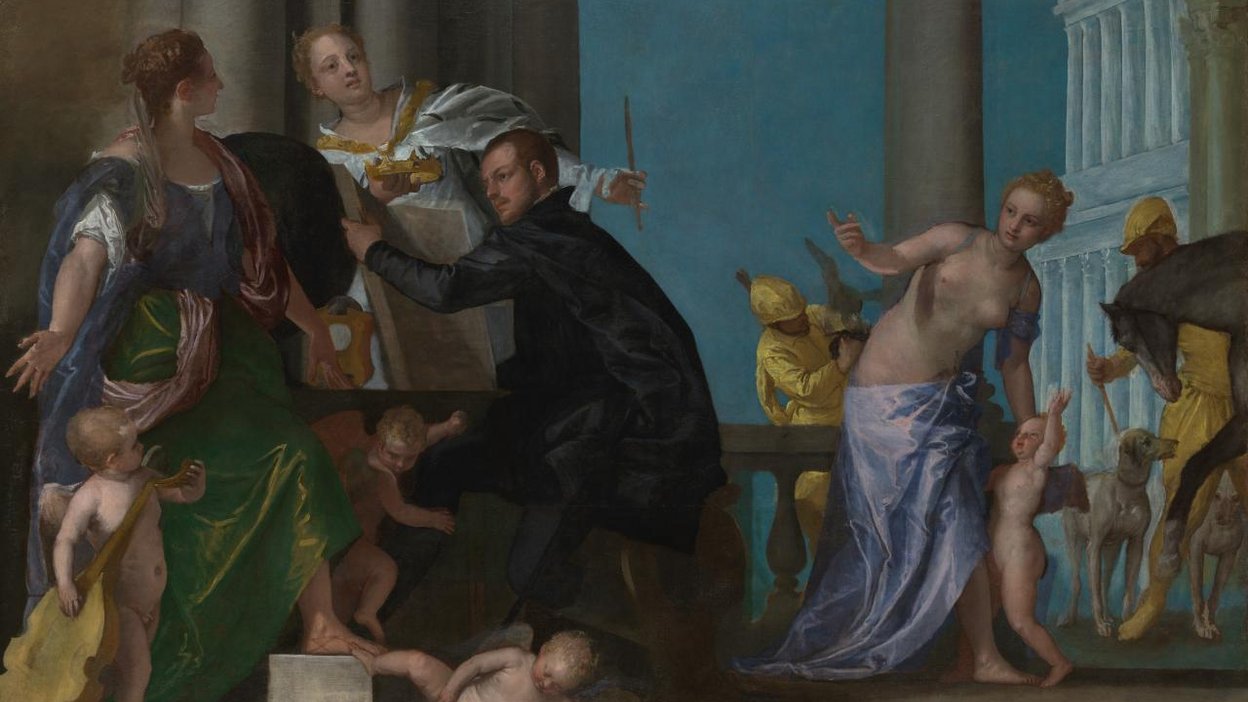
Art picked up on such a shift at an early stage: The painted scene shows a large folio, leaning against a globe, behind it sits a young nobleman dressed in a black silk coat. Beside him, two ladies vying for his attention. On the left is Minerva, the goddess of wisdom, the expression and embodiment of the contemplative life. With her left foot positioned on a stone block, she symbolises calm and stability. Behind her is Juno, holding a crown and sceptre, symbols of the active life. Her arm points to the right. Against the backdrop of a marble palace stands Venus, surrounded by hunters, a horse, falcons and dogs – signs of a life of joy and pleasure.
This painting was created around 1575 in the workshop of the renowned Venetian painter Paolo Veronese. The struggle between virtue and passion was a relatively popular subject in the circles of the European nobility and upper classes at the time. The chosen motif was representative of the courtly culture of the day. Their love of play, exertion and grandeur, their longing for endless fame and splendour, their rejection and distancing from all activities bearing the stigma of need, physical and manual labour, practical constraints or material circumstances.
The pace and depth with which this culture spread amongst the European upper classes varied greatly according to place and circumstance. In the context of historical Venice, this painting was symptomatic of a profound and dramatic cultural shift that was to fundamentally transform the city and its rule in just a few decades: the turning away of its elites from the world, from the cose del mondo (things of the world).
In the preceding centuries, Venice had been widely renowned for a whole range of things. These included its freedom, its wealth, its political constitution and institutions, its status as a city that had never been conquered, its architecture – and finally: the distinctive nature of its patricians, the gentilhuomini, who were closely linked not only to politics but also to the economy and the sphere of commerce. Whilst in much of Europe at that time the aristocratic upper class traditionally lived off the rents and yields of their own landholdings, Venice was ruled by families who were heavily involved in commercial activities; whereas elsewhere young nobles received their education through private tutors, at universities, in military service or in court offices, the Venetians sent their offspring to learn their trade on ships, on trading voyages, at fairs and in foreign trading posts before they entered service of the Republic.
In the decades preceding the creation of the painting by Paolo Veronese, ever-widening cracks began to appear. In his De magistratibus et republica veneta, published in 1543, the Venetian scholar, politician, and later Cardinal Gasparo Contarini made similar observations. With a melancholic undertone, he noted that the "ancient laws and noble institutions still continue even to this day, though various young men, having been corrupted since the expansion of our dominion either by ambition or riot, have neglected their country’s customs". This neglect, however, was not rooted, as suggested here, in the fleeting whims of young Venetian patricians, but in fundamental, structural changes in the economy and politics of the Serenissima.
Accelerated by Venetian conquests on the Italian mainland and the growing risks to maritime trade created by competition and war, an increasing number of Venice’s gentilhuomini in the late 15th century began to acquire estates in the region of present-day Veneto and beyond. Consequently, a growing number of patrician families withdrew from active political participation in shipping and commerce. Leasing out arable land or supplying the city of Venice with agricultural produce promised a comparatively secure income. In line with prevailing conditions in continental Europe, major parts of Venice’s ruling class thus transformed into a landed aristocracy. A pattern that recurred regularly in the coming centuries and across various regions of the world: A phase of openness and dynamism is followed by a phase of stagnation and isolation – largely caused by the retreat of local upper classes into the mostly illusory security of immovable and positional goods.
The consequences of this reorientation in Venice were dramatic. They affected and fundamentally altered the structure and organisation of society. As early as 1509, the Venetian merchant, banker and historian Girolame Priuli complained furiously in his Diari that the young now longed solely for courtly pleasures, partly because the merchant elite had transformed itself into a bunch of landowners and rentiers, "senza experientia dele chosse del mondo," without knowledge of the concerns of the real world.
This was not merely a decline in knowledge and expertise in commercial matters. The problem ran deeper. The turning away from the day-to-day issues of economic life was accompanied by a broader retreat from the practical affairs of the Republic, that is to say, the day-to-day business of politics. In this sense, the movement into the private sphere of one’s own country estate was representative of a specific attitude which an increasing number of members of the nobility adopted towards the affairs of state – an attitude of detachment, of non-involvement, of ignorance and rejection of the empirical reality and practice of community.
Why did a republic that was home to one of Europe’s first agricultural academies implement so few innovations in agriculture? Why did a republic that played a key role in establishing the modern patent system never realise large parts of its ideas and inventions? Why did a republic that once held a leading position in shipbuilding lose its technological edge to the English and Dutch as early as the end of the 16th century?
In his work Della perfezione della vita politica, written between 1572 and 1579, the Venetian historian and statesman Paolo Paruta devoted the entire first volume to attempting to convince his audience of the value of the vita civile, a life in the service of the public good. Withdrawal into a private existence, he argued, would inevitably bring disaster upon the state and its members. The opponents in his dialogue, entirely in keeping with the zeitgeist of the Venetian aristocracy, resisted this appeal. They painted the vita civile in gloomy colours. Anyone who engaged with this earthly world, with the trades and affairs of the Republic, "did nothing other than set out onto the open sea churned by winds, as if he took pleasure in exposing himself to the whims of fortune."
No private capital, no institutions, no wealth of knowledge could ultimately outweigh this turning away from what Girolame Priuli called the "chosse del mondo". By the early 17th century, the connection with the rising powers of the Atlantic had been lost for good.
When the world changes and things are in a state of upheaval, distance and detachment offer a sense of security and peace. On the one hand, the idyll of retreat, family, and privacy; on the other, a sheltering from the unrest, uncertainty, and confusion of external circumstances. This consequence remains as clear and understandable today as ever. It points to a fundamental ethical question: the relationship between freedom and responsibility. The Venetian patricians in Paolo Paruta’s aforementioned work knew and described themselves as free beings. At the same time, some among them hoped that virtue, like their freedom, was bestowed upon them by nature and birth. A contradiction that virtually infuriated the protagonist of the first volume, the Venetian ambassador Michele Suriano. If we truly believed that "virtues are natural, how can we defend their dignity? Then good deeds would soon lack merit; virtuous people would be deprived of all their rewards; laws would be made in vain, the many precepts of the philosophers on the good life would be in vain, and all civil orders would be utterly ruined."
Alongside the very practical problem of a decline in competence – in both economic and political matters – resulting from ignorance of the "chosse del mondo", the act of turning away is revealed here as a question of individual and social responsibility. One might also speak of a virtue of devotion, of not turning away, an expression of the freedom of all those who could choose otherwise. It was, and remains, essential to remain engaged.
The Republic of Venice, which in times of crisis repeatedly had to take out interest-bearing loans from its own population, found itself heavily in debt by the end of the 16th century. The burden of interest and repayment grew ever heavier. While great wealth continued to exist within families – in terms of financial resources, but also in terms of skills and commitment – the public sphere (in all the dimensions mentioned), as a mode of association beyond the private sphere, was visibly impoverished. In a society where the withdrawal from the realities of society affects significant sections of the political and economic subjects, and where too little is invested in the shared world of a community, a lack of future prospects is almost inevitable. Stagnation and stunted development then become an almost inevitable consequence. Everything else is and remains a question of freedom.
Book
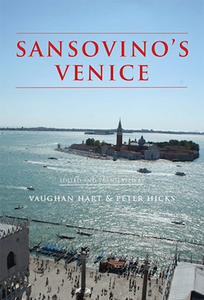
There are many publications on the crisis in Venice in the 16th century. Rather than providing bibliographical recommendations, here is a travel suggestion. The city's former commercial splendour and strength are still tangible today. The same applies to its leading role in long-distance trade and the arts and crafts. You can visit the Fondaco dei Tedeschi, where goods from St Gallen were sold in those days; Murano, whose glassware was shipped as far as the New World; and the Arsenale, one of Europe’s first proto-industrial complexes. To accompany your travels, I recommend Francesco Sansovino’s city guide, first published in 1581 and now available in a new English edition by Vaughan Hart and Peter Hicks. Sansovino wrote this book with the intention of conjuring up an image of unity in the face of the ever-widening rifts in the Republic’s political and cultural fabric. For those wishing to trace the fault lines addressed in the book, an excursion to the mainland to visit a villa—the newly built country estates of Venetian patricians at the time—is highly recommended. A prime example is the Villa Barbaro in Maser, designed and built by the renowned architect Andrea Palladio. It epitomises the inner turmoil of the upper classes at that time. The villa's patrons, the brothers Marc’Antonio and Daniele Barbaro, spent their entire lives exploring the tension between the countryside and the lagoon, private idyll and public affairs, and detachment and engagement through letters and books.