




Article

Article

What does the future of capital markets have to do with re-interpreting freedom? At first glance, the answer seems straightforward. Capital markets are often associated with economic freedom. They allow firms to raise funds and allow companies to grow. They also provide saving and investment opportunities for individuals. Capital markets can broaden opportunities and support innovation. Market prices influence how companies access capital.
But this is only half the story as capital markets also have a signalling, disciplining, and legitimizing function. They are a place where decisions are made. Market prices reveal a clear story: they show exactly which companies are winning funding, which corporate strategies are being rewarded, and which risks investors are willing to take. Capital allocation, therefore, can decide how and in which directions our economies develop.
This becomes particularly important when we look at the changing role of corporations in our society over the past decades. We live in a rapid changing world, and we are confronted with pressing issues. Companies are no longer judged solely by their profits. Customers, employees, and investors expectations have changed, and companies are expected to respond to climate change, social inequality, technological disruptions, and political contexts. While some welcome the rise of corporate responsibility, others fear it gives managers unchecked freedom to pursue their own interests. Yet before asking whether corporations should pursue goals beyond financial returns, we need to ask a more basic question: who gets to decide?
One answer is: the shareholders. Through their votes, shareholders elect boards of directors and express their views on executive compensation, corporate restructurings, governance rules, and an increasing number of environmental and social proposals. This is sometimes described as “shareholder democracy”. The comparison is of course imperfect. Unlike in the political context, corporate voting is built on capital rather than citizenship: the more shares an investor holds, the greater their influence. Furthermore, investors can actively scale their voting power up or down simply by buying or selling shares. Moreover, shareholders are not the only group affected by corporate decisions. Employees, customers, local communities, and future generations may also have substantial interests at stake but might not belong to the circle of voting shareholders. Finally, many shareholders do not cast their votes directly. Instead, they rely on intermediaries such as asset managers, pension funds, and proxy advisers. A setup that raises questions about whose preferences are ultimately represented. Nevertheless, both settings, confront a similar challenge: formal participation does not automatically guarantee meaningful voice.
Casting an informed vote takes time and attention. For an individual investor, becoming informed by reading regulatory filings may be difficult to justify. Especially if the investor holds a diversified portfolio. For a pension fund or asset manager, the sheer volume of annual votes can be so high that they rely on intermediaries. This is where the concept of freedom becomes more demanding. Freedom is not only the absence of constraints. It also is the ability to exercise choice in practice. A voting right that is too costly or too complex to use may exist on paper while remaining weak in substance. The same applies when voting becomes a box-ticking exercise or when a handful of institutions gain disproportionate influence simply because others fail to participate.
During my time at the St.Gallen Collegium, I studied the design of Corporate Voting as I believe that it matters how information is presented and how ballots are structure. While these factors are known to play an important role in political elections, they are equally significant in the corporate world. Looking ahead, digital tools and AI promise to lower the barriers to participation, but we can't ignore the potential risks. If corporate voting decisions are outsourced to algorithms, voting becomes easier but at the same time genuine participation will be reduced. The challenge is and will be to design system that aggregate preferences more accurately. Of course, corporate democracy is not a complete answer to the social responsibilities of business. Still, it's a key part alongside regulation. The more we expect corporations to balance multiple objectives, the more important it becomes to understand how their owners express priorities and how managers interpret them. The future of capital markets is about returns, new technologies, and also about governance. Markets can expand freedom, but this does not happen automatically. Their rules determine whose choices count and whose voices are heard.
Re-interpreting freedom in capital markets means moving beyond the simple idea that fewer restrictions always create more freedom. It means asking whether people can exercise agency through the institutions that invest their savings and shape the economy around them. The task ahead is to build capital markets whose rules make freedom more meaningful.
Book
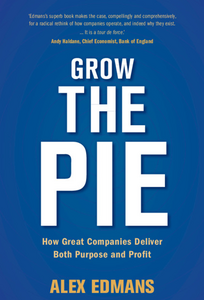
A timely exploration of corporate responsibility. Engagingly written with many real-life examples.
Podcast
An accessible way to hear corporate governance debates through expert conversations that connect technical rules to their real-world consequences.