





Article

Article

Dietmar Grichnik, at the START Summit 2026 in St.Gallen, the term “Alpine Axis” was very much in evidence – startups, students, politicians, as well as you and investors, were all talking about it. What does this idea entail?
Dietmar Grichnik: The “Alpine Axis” is, first and foremost, a new narrative about an innovation hub that is not precisely defined geographically. It stretches from Lausanne via Zurich and St.Gallen to Munich, and in some cases further to Grenoble, Vienna and Milan. Along this axis are world-class universities such as the EPFL, the ETH, the TUM and HSG – and, linked to them, a strong ecosystem for technological development. Specifically, around 1,100 deep-tech startups, including many “unicorns” have emerged in the region since the year 2000. So, the region’s strengths are already in place. The fact that the Munich–St.Gallen EuroCity train still takes three hours today shows, at the same time, that whilst we call it an axis, we are not yet travelling at high speed along its entire length.
Andreas Göldi, you have founded companies in Europe and the US and now invest in technology-driven startups. How important is geographic proximity for an innovation and economic hub?
Andreas Göldi: Historically, innovation has always been concentrated in geographically dense regions. Silicon Valley and Boston are good examples. There, leading universities, companies, capital and talent are all clustered within a small area. Excellent research has long been carried out within the Alpine Axis. For example, the foundations for the internet were laid at CERN in Geneva, but it was US companies that subsequently commercialised the idea. This was partly because the communities within the axis and across Europe as a whole did not collaborate enough. Even in the 1990s, when I was studying at HSG, members of HSG and ETH communities hardly spoke to one another. That is now changing. Many partners from the worlds of research, politics and business have realised that the question is not whether Zurich, St.Gallen or Munich are strong in their own right. True strength comes from collaboration.

“The foundation for the Internet was laid at CERN in Geneva, but it was US companies that eventually commercialized the idea. This was also because the communities within Europe didn’t collaborate enough.”
Lena-Marie Pätzmann, you completed your PhD at HSG and subsequently co-founded the startup Sitegeist Robotics at TUM, which develops semi-autonomous construction robots. How did you experience the connection between the two locations?
Lena-Marie Pätzmann: For me, it was very tangible. I met two TUM students at a hackathon at Google Munich. They showed me an early robot prototype and were looking for someone to develop the business side and draft a research proposal. This initially led to a year as a research associate at TUM and ultimately to the founding of Sitegeist Robotics. My role, given my background at HSG, was also to investigate how the research could be translated into a marketable product. Discussions with customers, for example, showed that there is a real need for construction robots. At the same time, the technology had to be presented in a way that was understandable and engaging to customers, investors and future employees. For me, this combination of technology and business is at the heart of this axis. It’s also fitting that I met most of our investors at the START Summit in St.Gallen.

“With my background at the University of St.Gallen, my task was also to examine how research can be translated into a marketable product. For me, this connection between technology and business is at the heart of this axis.”
Johannes Aicher, you founded the spin-off Avientus at ETH Zurich, which develops transport drones for defence and dual-use applications. The company is now based in Zurich and Munich, and Avientus took part in the HSG START Accelerator programme in St.Gallen in 2025. What has been your experience?
Johannes Aicher: We actively seek collaboration with HSG to bring in an additional perspective – for example, through participation in the HSG START Accelerator, or through collaboration as part of HSG courses: HSG students, for instance, developed a marketing concept for us, which provided valuable input. The challenge lies in establishing this collaboration as early as possible – that is, before a research project has turned into a startup. The further along a deep-tech startup is, the more difficult it becomes to bring in an external business partner who truly understands it.
Lena-Marie Pätzmann: My experience also shows that this combination of perspectives is particularly valuable for deep-tech startups. During my doctorate at the HSG Institute of Information Management, I researched how research is transformed into marketable applications. At TUM, I was able to put this into practice through academic exchange with my co-founders.
Dietmar Grichnik: It is precisely this kind of early collaboration that we will be fostering at the HSG ETH Student Project House, which is just getting underway. Students from HSG, ETH and also OST will work there on joint projects with an open-ended approach. The aim is for startups to emerge from these projects as they progress. In addition to this new facility, HSG Entrepreneurship runs several support programmes for HSG startups at various stages. Often, the first step in fostering entrepreneurship is to break down barriers. The HSG START Accelerator works in the same way: it is supported by the ecosystem in and around St.Gallen, whilst at the same time attracting deep-tech startups from Munich, Zurich and Lausanne.
Andreas Göldi: From an investor’s perspective, too, the combination of technological and business perspectives is key. In the past, we were often frustrated when an outstanding product emerged from the University of St.Gallen but lacked a commercialisation strategy.
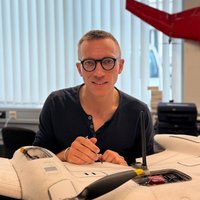
“As a DeepTech startup, we’re actively seeking collaboration with HSG to bring in an additional perspective.”
So the region already has a lot to offer. What could still be improved?
Johannes Aicher: One difference compared to Silicon Valley or Boston is actually quite obvious: there are national borders within the Alpine Axis and across Europe. In mid-September, we were at a NATO military exercise in Portugal with our drones and had to spend several hours on customs formalities. I also have the opportunity to test our drones at a German Bundeswehr airfield. However, because we develop our products in Zurich, getting the drones across the border involves a fair bit of red tape. At the same time, our branch in Munich is important to us because Germany invests heavily in defence drones. Whilst the economic links within the region are very strong, bureaucracy is holding us back.
Dietmar Grichnik: There is a significant funding gap. A deep-tech startup needs between 50 and 200 million Swiss francs in investment to move from the laboratory to industrial production. In these later funding rounds, the European investor chain often breaks down and the next investor is based in Boston or Palo Alto – and with the capital, control, value creation and, ultimately, the headquarters and talent migrate elsewhere. We need a different mindset in the region. For example, pension funds in Switzerland are permitted to invest up to five per cent of their pension assets in venture capital – but in reality, the figure is only 0.02 per cent. Highlighting the Alpine Axis and its potential could help to trigger a shift in thinking here. And there are a number of initiatives at European level aimed at closing the funding gap, such as the Scaleup Europe Fund, which is set to raise up to 5 billion euros. But a lot is happening at regional level too: for example, politicians, business leaders and researchers from Zurich, St.Gallen, Bavaria and Baden-Württemberg meet regularly for round-table discussions. The aim is to discuss potential collaborations and mutual needs in an accessible way. Often, the state is the first major client for young technology companies. In our case, it is often the last.
Lena-Marie Pätzmann: Even we, as a startup with a three-person founding team and nine employees, are already in talks with US investors with a view to future scaling. At the same time, our commitment to strengthening Europe as an industrial hub lies at the heart of our strategy. In discussions with European investors, we notice that the first question is often: „And what if it doesn’t work out?”. Yet the question should really be the other way round.
Andreas Göldi: Anyone who portrays the US as a strong market for innovative companies must not forget that, for many startups there, the government is one of the key customers – for example, in healthcare or security. The Pentagon alone spends 10 billion dollars a year on AI projects. There is still some catching up to do in this regard along the Alpine Axis.
Lena-Marie Pätzmann: Government funding schemes such as Innosuisse or Exist in Germany are vital for deep-tech companies. Thanks to an Exist grant, we too were given the time to develop a business from a research project without market pressure. The government’s role as a major or first customer for startups is indeed still under-represented in Europe. Often, the terms of tenders are worded in such a way that a startup stands no chance.

“In later funding rounds, the European chain of investors often breaks down, and the next investor is based in Boston or Palo Alto—and along with the capital, control, value creation, and ultimately the headquarters and talent migrate elsewhere.”
Let’s look ahead – what would need to have happened in five or ten years time for you to be able to speak of a strengthened Alpine Axis?
Dietmar Grichnik: By then, it should be second nature for talented individuals to move along this axis. Students and researchers from Munich should be able to undertake a project in St.Gallen or Zurich without major hurdles, and vice versa. A start-up should be able to bring together talented people from several universities. And an investor should perceive the region as a cohesive innovation hub.
Johannes Aicher: It should be normal for start-ups to operate from multiple locations, depending on where research, talent, customers and capital are most readily available. A space in which it is no longer a crucial question for a start-up which side of a border a particular competence lies on.
Andreas Göldi: If a company from this region is successful, it shouldn’t eventually be forced to move to America simply because the next round of funding is only available there.
Lena-Marie Pätzmann: As a robotics founder, I’d also like to see even more robotics companies springing up along this axis – and for this field to be viewed holistically. Why not establish a chair in robotics at HSG?
Johannes Aicher is co-founder and CEO of Avientus, an ETH spin-off that develops autonomous transport drones. Aicher studied at the ETH, where he helped build an electric racing car whilst completing his degree course. Avientus is working on logistics solutions for hard-to-reach and challenging operating environments and is now also active in the European defence sector. Avientus took part in the HSG START Accelerator programme in St.Gallen in 2025.
Andreas Göldi is a partner at the venture capital firm b2venture. b2venture invests primarily in technology-driven European start-ups and connects founders with a community of hundreds of angel investors. Göldi studied at HSG and founded Namics in 1995, which, now operating under a different name, is one of Switzerland’s leading digital agencies. He later founded and developed several software companies in the USA.
Dietmar Grichnik is professor of Entrepreneurship and Technology Management, as well as Vice-President for Innovation & Quality at HSG. He also helped establish HSG Entrepreneurship, the HSG START Accelerator and the HSG ETH Student Project House, and is active as an investor and supporter of start-ups. His research focus is on, amongst other things, technology entrepreneurship, longevity science, start-up and scale-up management, and entrepreneurial finance. In 2026, he and start-up founder and HSG researcher Robert Schreiber jointly received the HSG Impact Award for developing an AI-based solution to tackle malnutrition in the healthcare sector.
Lena-Marie Pätzmann is co-founder and CEO of Sitegeist Robotics. The start-up develops semi-autonomous construction robots. These are designed to take over tasks that are dangerous, harmful to health or time-consuming for humans, thereby improving safety and efficiency. Pätzmann studied and completed her PhD at HSG and was a research associate at the TUM. Sitegeist Robotics recently carried out its first tunnel refurbishment using a construction robot at an Audi plant.
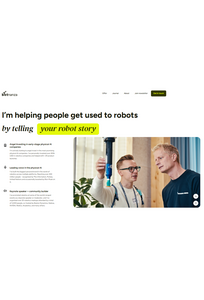
Website
Botnanza operator Lukas Ziegler is an angel investor in robotics start-ups. He also advises start-ups, investors and companies on robotics and AI. Ziegler regularly posts reports on global developments in robotics and offers a newsletter.

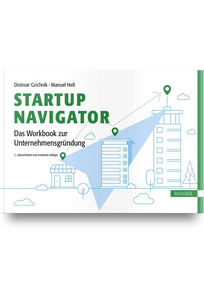
Book
The book brings together knowledge, tools and practical advice for the various stages of setting up a business – from the initial idea through to building a company. A concise guide for anyone wishing to approach entrepreneurship systematically.

Book
A modern standard reference work on the topic of negotiation.
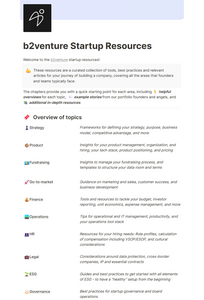
Website
A collection of articles, tools and best practices relating to the founding and development of a start-up. The collection is curated and vetted by experienced investors and founders.