




Article

Article

The summer of 2026 showed that heat is a public health issue, especially at night. The HSG startup NoxBlanc is developing a mattress that, amongst other things, can be cooled.
The summer of 2025 saw Zurich in the midst of unbearable heat for weeks on end. Michael Gregers’ baby had restless nights the sweltering flat. “I then put my son on our guest bed, where we set up our test mattress. One of the features is that you can cool the mattress. The little one fell asleep on it within a few minutes,” says Greger. As a father, he was relieved. “And as an entrepreneur, this was a first ‘wow’ moment and confirmation that we’re on the right track.”
Michael Greger, 33, began developing his startup in 2024, straight after obtaining his doctorate at HSG; the company has operated as NoxBlanc AG since July 2025. He had previously obtained his undergraduate degrees at HSG. “Many of my university friends are now earning good money, whereas my co-founders and I are still living from month to month like students. That’s a conscious decision: every franc we don’t spend on ourselves, we invest in the company and, in doing so, in our independence.” What drives him is his vision. “With NoxBlanc, we want to develop the next generation of mattresses. If we succeed, we can make a positive difference to many people’s lives.”
It all began with intensive research. Greger reviewed around 65 scientific papers on mattresses and analysed existing products worldwide as well as the patent landscape. “A large proportion of the studies were of limited significance. However, some papers provided initial indications that adjusting firmness and temperature can influence sleeping comfort and possibly also sleep quality.” The market analysis also gave him cause for optimism. “Virtually no supplier has yet combined both functions in a fully-fledged mattress.”
Based on these findings, the team developed a patent-pending system that combines active firmness and temperature control in a single mattress. Both sides of the bed can be adjusted independently of one another. External sensors monitor the sleeping environment and complement the mattress.
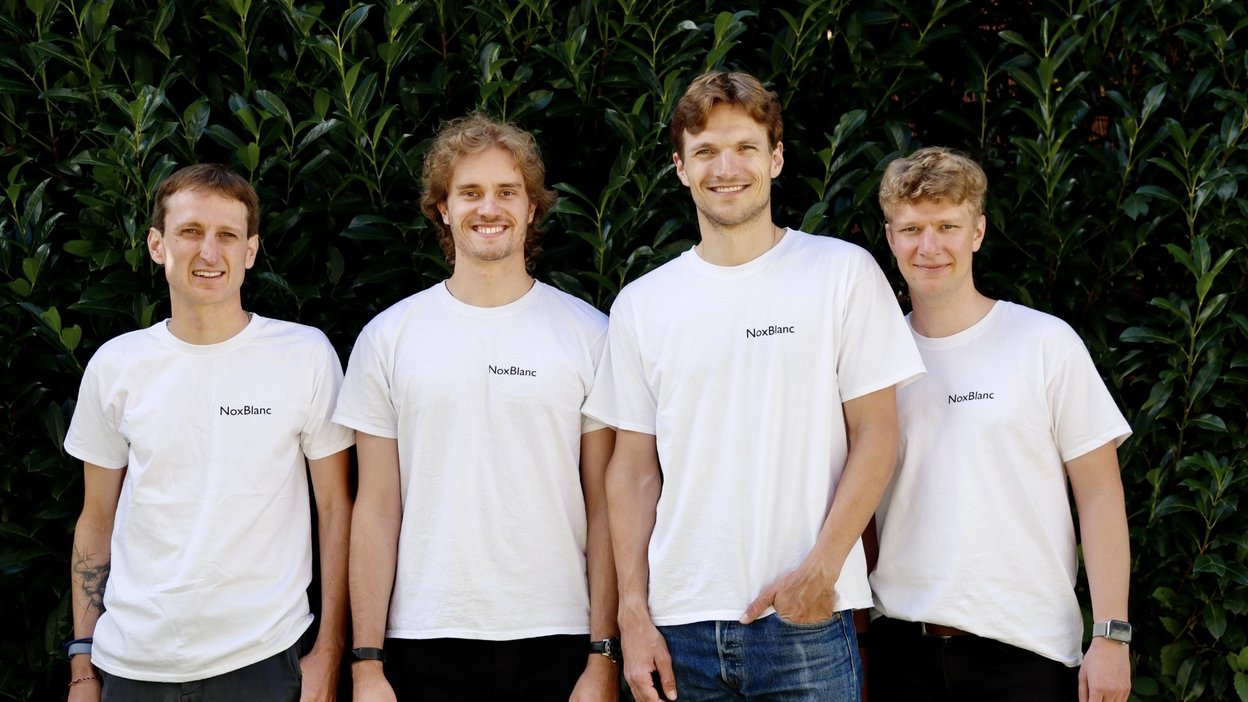
An interdisciplinary team is working on this. Together with Kristófer Reynisson (Computer Science, HSG), Luka Vego (Industrial Design, ZHdK and BFH) and Linus Rüttimann (Electrical Engineer, ETH), Greger is developing this mattress and the business model surrounding it. The startup deliberately operates with a lean infrastructure: development takes place in-house, whilst four Swiss suppliers handle production.
Despite the uncertainty – particularly as a young father – Greger emphasises: “I wouldn’t have it any other way. Building something with my three co-founders under the fantastic conditions here in Switzerland is a privilege.” Yet the past few years have been emotionally draining. “At the start, I still had regular bouts of self-doubt. I often didn’t know whether continuing with the project was still justifiable to my family. You certainly need composure and perseverance. Above all, though, you need a cohesive founding team and the support of those closest to you.”
The first steps toward success have been achieved and the team is testing a prototype of the mattress. As part of a project partnership with the Swiss Olympic Innovation Hub, 30 athletes, including Olympic participants, are testing NoxBlanc’s sensor technology and app. The findings are being incorporated into further product development.
“Sleep is of central importance for all sports, but there is still little knowledge about how to optimise it, particularly before competitions,” says Robin Dreyer, who heads the Swiss Olympic Innovation Hub. The Hub connects the startup with the athletes, including rowers and track and field athletes. “We want to find out how the athletes sleep today, what conditions prevail in their sleeping environment, and how the NoxBlanc system is being adopted in everyday life.” With a view to the next Olympic Games, Swiss Olympic aims to better understand recovery through sleep and, where possible, improve it, according to Dreyer, who also studied at HSG.
The potential is huge. “After the 2024 Summer Olympics in Paris, we conducted in-depth surveys with our athletes. It became clear that getting a good night’s sleep – particularly in a new location – was a major challenge for many.”
The Innovation Hub supports up to 20 projects a year in the field of innovation and sport. The aim is to generate knowledge and develop tools that are then shared with various Swiss sports federations. “The topic of sleep, in particular, affects us all: elite athletes, young athletes, but also the general public. New knowledge in this area is valuable for many groups,” says Dreyer.
A major question for startups is always how to secure funding. So far, NoxBlanc has largely financed itself through its own funds. In recent years, support has come from public and private institutions as well as from various startup and innovation programmes. These include, for example, the Gebert Rüf Foundation with its First Ventures Programme and the EU’s DeepTech Venture Building Programme. In addition, Greger was accepted into the HSG’s “Entrepreneurial Champions Programme”at the beginning of September 2026. This programme provided him with a total of 100,000 Swiss francs over the course of a year, as well as a network of mentors and investors. The HSG programme focuses on technology-driven startups. “That’s very good – we’re not a traditional mattress manufacturer, but rather a technology company. We want to combine as many natural materials as possible with technology in such a way as to create a new sleeping experience for our customers,” says Greger.
Whether this will actually result in a marketable product remains to be seen. Greger is, however, convinced that it will succeed. “We have already received initial pre-orders from elite athletes and private individuals. In product tests carried out so far, more than 90 per cent of test subjects stated that they wanted to replace their current mattress with a NoxBlanc.”
By the end of the year, NoxBlanc is set to start delivering its first mattresses – albeit without the temperature module, which is due to be available in 2027 and can be attached to the mattress via a zipper.
The NoxBlanc founders say that the importance of sleep for health and performance is now widely recognised beyond the world of sport. “The popular science book Why We Sleep by US sleep researcher Matthew Walker, for example, has contributed greatly to this. The podcast scene focusing on health and optimisation topics has reinforced this effect,” says co-founder Kristófer Reynisson. The heatwaves of recent summers have also shown that the sleeping environment is coming under greater scrutiny. For older people and other vulnerable groups in particular, hot nights can become a health burden.
And the outlook is worsening in cities such as Zurich, there is a risk of up to 45 tropical nights per year by the end of the century, during which the temperature does not fall below 20 degrees. When indoor temperatures exceed 24 degrees, mortality rates rise significantly and sleep quality suffers, as the Swiss Federal Office of Energy notes in a study. Because energy-intensive air conditioning is considered taboo in Switzerland, the Office has commissioned the development of cooling measures that work close to or directly on the body – including in bed. “The federal government proposes cooled mattresses,”read the headline in the Tages-Anzeiger in August 2025. Cooled mattress toppers and wearables may soon be the only way for people without a well-insulated flat in the north to sleep well.
This means that the topic of sleep becomes relevant beyond individual comfort. This is precisely where the collaboration between NoxBlanc and the Healthspan Lab, led by HSG Professor Dietmar Grichnik at the Institute of Technology Management, comes in: together, they are working on research projects into sleep and health, with an orientation towards women experiencing hot flushes.
The current climate and the topical nature of the issue therefore seem ripe for optimised – that is to say, personalised – sleep. The question, however, is whether this will actually create a market for a high-tech mattress costing several thousand francs. “We spend around a third of our lives on a mattress. At the same time, it is often chosen after only a brief trial, even though our bodies and comfort needs change over time. Given the rising awareness of health issues, we are convinced that there is also a growing willingness to invest in good sleep,” says Greger.
A recent study by the Gottlieb Duttweiler Institute supports the theory that health and wellbeing represent a growing market: according to the “Feelgood Revolution” study published in 2026, the global wellness economy was worth around 6.8 trillion US dollars in 2024. This figure is set to rise to 9.8 trillion by 2029.
Greger takes a pragmatic approach to the uncertainty surrounding his startup. “I believe that my generation, in a privileged country like Switzerland, not only has the opportunity but also the duty to make bold decisions,” he says.
His interest in performance, recovery and wellbeing dates back to his own sporting career. In his youth, Greger attended the FC Bayern Munich sports school in Munich and trained ambitiously every day. However, knee and hip problems set Greger, who stands at 1.97 metres. He was sidelined for a total of two years. “During that time, I became interested in how performance, recovery and wellbeing could be improved.”
Today, the former athlete is convinced that recovery is still underestimated in sport: “Athletes spend more time recovering than training. Nevertheless, the sleeping environment is rarely considered as systematically as training or nutrition.” As part of setting up NoxBlanc, he also interviewed a professional footballer who had already played in a Champions League final. “Before the final, he slept on a standard mattress costing a few hundred francs and was very interested in our idea.”
And what if NoxBlanc fails? Greger: “Even in the event of a ‘failure’, we’ve learnt a great deal and grown as people. Our vision of building the best mattress in the world drives us on, and we believe in it now more than ever.”

Book
This book explains sleep research in an accessible, everyday way and shows just how individual our sleep needs are.


Podcast
I learn a lot from other entrepreneurs’ experiences that I can apply to building my own business; I find the episode with BORA founder Willi Bruckbauer particularly inspiring.