














YouTube Video
Following his pardon, Milton tells his story once again in his own words. This is not a neutral film, and that is precisely why it is revealing: The case continues as a narrative, and this report provides the framework for examining what the film claims and what it substantiates.
Article
The source for the triad of competence, integrity, and benevolence. An essay from 1995 that still explains today why trust is not a feeling, but rather an expectation based on three verifiable characteristics.
Book
The standard text on the relationship between narrative and valuation. Damodaran shows how to translate a company’s story into numbers and, more importantly, where this translation falls short.
Website
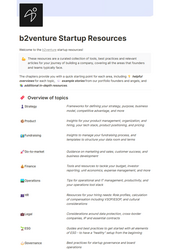
A collection of articles, tools and best practices relating to the founding and development of a start-up. The collection is curated and vetted by experienced investors and founders.
Book
A modern standard reference work on the topic of negotiation.
Website
The report that triggered the crisis. Worth reading as a case study on how to construct a counterargument: claim by claim, each backed by supporting evidence.
Book
The book brings together knowledge, tools and practical advice for the various stages of setting up a business – from the initial idea through to building a company. A concise guide for anyone wishing to approach entrepreneurship systematically.
Book
The full version of this article. The book systematically reconstructs the Nikola case and develops a framework for analysing the interplay of argumentation and narrative. Chapter 8.5 lists six warning signs for investors.
Website
Botnanza operator Lukas Ziegler is an angel investor in robotics start-ups. He also advises start-ups, investors and companies on robotics and AI. Ziegler regularly posts reports on global developments in robotics and offers a newsletter.
Podcast
I learn a lot from other entrepreneurs’ experiences that I can apply to building my own business; I find the episode with BORA founder Willi Bruckbauer particularly inspiring.
Book
This book explains sleep research in an accessible, everyday way and shows just how individual our sleep needs are.

Israel's election: What will it mean for Israeli democracy and society? 20 October 2026 — 14:00 TO 15:00 BST Anonymous (not verified) 12 October 2026 Online Ahead of a key election in Israel on the 27th October, experts assess the forces shaping the campaign and the domestic implications for both Israel and Prime Minister Netanyahu. Ahead of a key election in Israel on the 27th October, experts assess the forces shaping the campaign and the domestic implications for both Israel and Prime Minister Netanyahu. Since the formation of Benjamin Netanyahu’s coalition government, Israel’s politics, society and economy have undergone significant change. The question of national security has dominated the political agenda since the 7 October 2023 attacks by Hamas and Israel’s military offensive on Gaza. However, key domestic issues including accountability, the future of democratic institutions and the role of religion in the state are also on the ballot. The result could have lasting implications for Israel’s political system and broader social cohesion.This event discusses:What issues are shaping Israel’s election campaign?To what extent is the future of Israeli democracy on the ballot?What political scenarios could emerge after the vote?How could the result affect Israel’s economy and social cohesion?To what extent is the question of the conflict with Palestine being addressed by political candidates?
Chatham House
Direct evidence on the effects of financial sanctions remains limited. This column uses correspondent banking data to study how sanctions affect access to global payment networks. The dollar and euro networks offer the most efficient connections to banks in other countries. Furthermore, financial sanctions imposed during 2021-2026 reduced targeted banks’ access to major-currency networks, making it harder for sanctioned institutions to make or receive payments. Non-sanctioned banks in heavily sanctioned countries also lost connectivity to these networks but reoriented towards alternatives, particularly the Chinese yuan. More generally, shifts away from the dollar and towards the yuan remain minimal.
Center for Economic Policy Research
What matters more for sovereign credit ratings – today’s debt or tomorrow’s deficits? This column explores how ratings weigh the two and finds that ratings place much more emphasis on current debt than on projected fiscal deficits. Compared with the implications of a simple model, ratings differ in three important ways: they overweight debt relative to forecast deficits, they understate the effects of the interest rate-growth differential, and they are heavily influenced by other country-specific factors. Countries with the same debt and deficit forecasts can receive extremely different ratings, implying widely different levels of debt needed to reach a given rating.
Center for Economic Policy Research
UN Secretary-General António Guterres has condemned a Houthi missile attack on Riyadh’s main airport that Saudi authorities say killed 12 people and wounded more than 300.
UN News
Jeremy Strong in “The Social Reckoning,” Jesse Eisenberg in “The Social Network” and the real Meta executive are all playing parts. But only one has changed his approach.
New York Times Business
Beirut wurde einst als Paris des Nahen Ostens verklärt und später zum Sinnbild eines nicht enden wollenden Bürgerkriegs. Mounir Zahran legt verschiedene Zeitschichten dieser Stadt frei - eine Spurensuche zwischen Wiederaufbau und neuem Grauen.Von Mounir Zahran
Deutschlandfunk